

The Recycled Image
Ratio(s), Patterns & Energy, and the Equation at the End of Infinity

Besides maybe my essay on angels, this is my most speculative yet, and definitely my longest, something I haven’t been able to get past finishing for months in order to more leisurely examine the individual aspects of the “recycled image” or the “Medieval vision” of the cosmos made new again. Thanks to Mark Bisone, whose own 25,000 or so word opus, What Reaches Back was a primary inspiration for this overly massive (and scattered) set of reflections on what the world fundamentally is, and is for. It’s 10,000 words, yet still somehow only covers a quarter of what I wanted it to, so for now, maybe it’s Part I of a series, though it’s also a sequel in a way to my “It’s Fractals All The Way to Infinity.” To anyone who manages to make it all the way through: thank you for reading!
If these thoughts feel too speculative or are taken too far for your taste, please take them only as metaphors!
Table of Contents
Part III: The Equation At Infinity
Preface
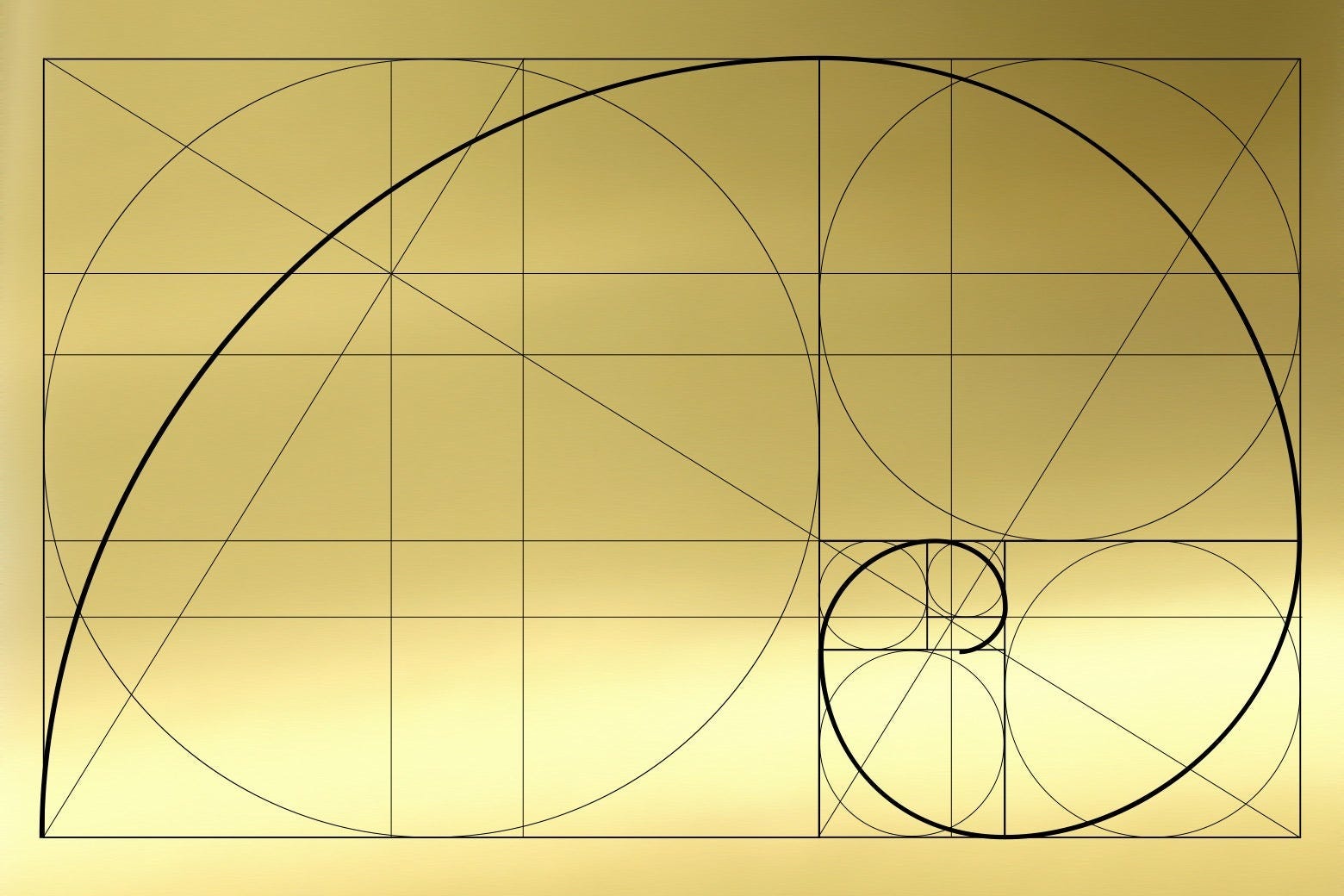
Whatever’s going on in mathematics, regardless of how hardened an atheist’s heart is, it’s powerful enough to break even that if he really stares at one of these Mandelbrot set visualizations, the golden ratio, or the multidimensional rose window—err, E8 root system long enough.
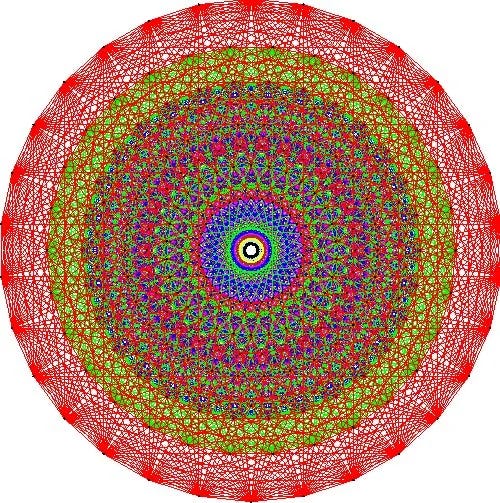
It will certainly break your mind too if you stare at it for too long:
Leave aside the visual stunningness of what is literally in these visualizations, a plunge into infinity, or even the omnipresent appearance of fractal patterns throughout nature; even more prosaic mathematics hides a similarly mind-breaking question: where does mathematics come from? Why does it work so well in describing the physical world?

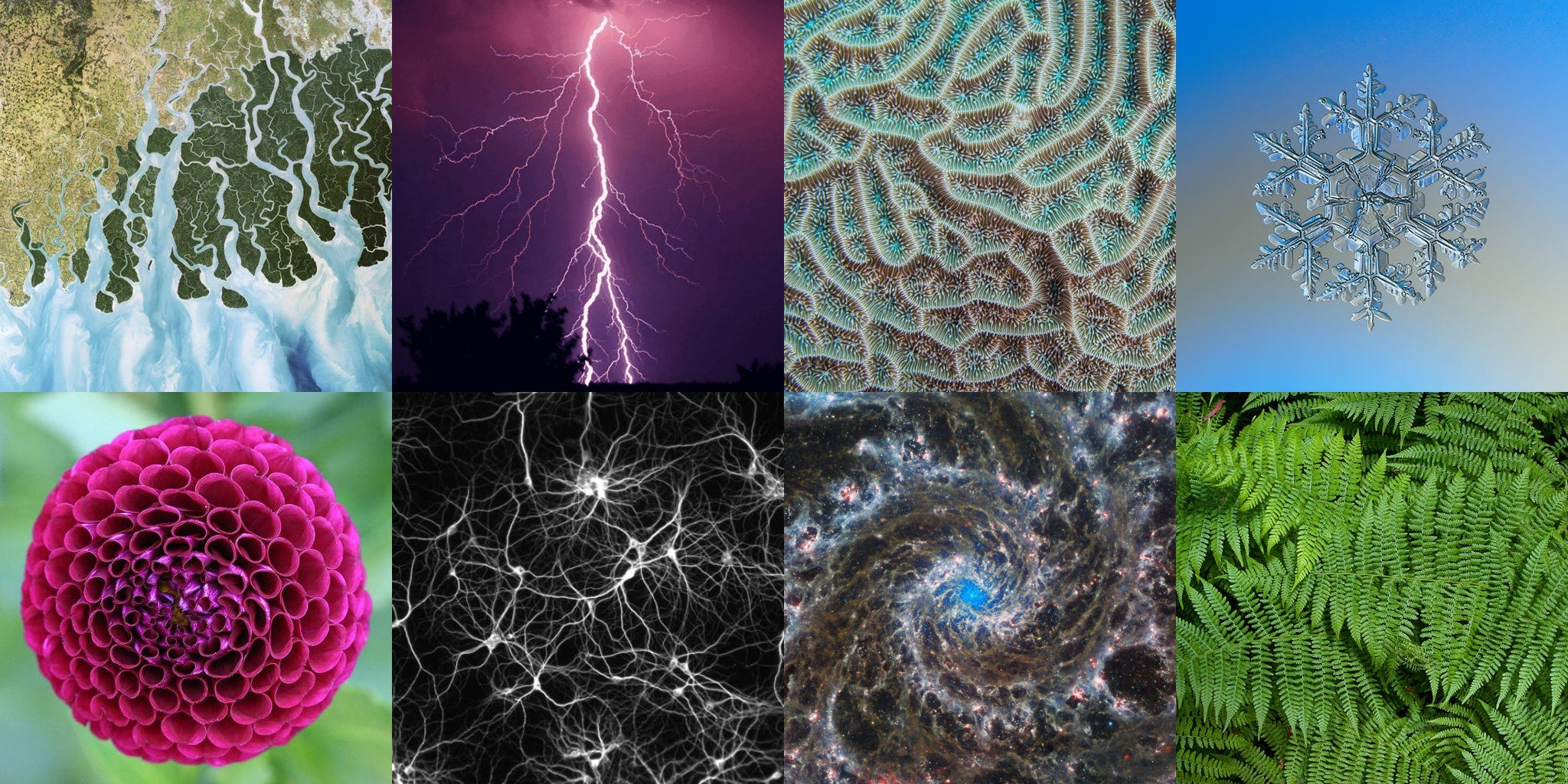
Of course, the basic answer most would give is that it comes from the world, but that merely pushes the question back one step, mystery and paradox remaining unfazed.
The fact that the laws of nature are written in the language of mathematics is, as mathematician Eugene Wigner put it back in 1960, “something bordering on the mysterious and that there is no rational explanation for it.” Science, as noted by John Psmith here, often proceeds by looking for mathematical symmetries first and then checking to see if these symmetries can be mapped onto the physical world.
This works so often, Wigner noted, that it’s “uncanny.” It can’t be merely that mathematics is (entirely) a subjective human-made endeavor for modelling the world, like a painting of a starry landscape, but that it is a discovery of some invisible, or difficult to see, objective order, that is far more unified than the cacophony of complexity that we see on the surface.
But while mathematics, used, especially after Descartes, as the final and surest mode of reasoning in every discipline, certainly unifies the sciences, this unity, also ever since Descartes’ revolutionary ploy to treat all types of magnitudes as theoretically of the same kind, also comes at a cost of deeper unity.
Mathematics, for its part, has lots to say when you stay in the lane of abstract (or even more abstract) quantity, but little to say about where its laws come from. Physics is also good for exploring the interactions of particles, their charges, forces, and motions. But when it comes to what these particles “are”, or are made of, or why they, when combined in atoms and molecules, produce chemicals with the properties they do, physics’ answers are far less clear. Each of the sciences has depth, but not breadth. Answers are mathematically detailed, yes, but the detail gives nothing to the imagination. You can know the mass of the proton and the coupling constant of the strong nuclear force to 12 decimal places or estimate the number of stars in the universe or evaluate the properties of a synthetic chemical compound, but each of these answers bears little connection to the others, meaning that, even as the circle of facts illuminated by scientific inquiry increases, the number of shadowlands where science has no clear answer has actually increased.
As science’s sub-disciplines have become more detailed, the panoply of understanding of the world has grown more niche and divided, and the number of blurry areas has commensurately increased. Science can tell a detailed set of stories with big words, but it fails to tell a single story.
![OC] Growth in Scientific Publications Per Year Has Been Skyrocketing: pulled from https://freaktakes.substack.com/p/what-should-new-age-research-organizations : r/dataisbeautiful](https://substackcdn.com/image/fetch/$s_!KCEn!,f_auto,q_auto:good,fl_progressive:steep/https%3A%2F%2Fsubstack-post-media.s3.amazonaws.com%2Fpublic%2Fimages%2F995db85a-020c-4ab8-86a5-426eb8b2d873_1344x960.png "OC] Growth in Scientific Publications Per Year Has Been Skyrocketing: pulled from https://freaktakes.substack.com/p/what-should-new-age-research-organizations : r/dataisbeautiful")
In a way, it’s in the nature of science, ever since the Baconian and Cartesian revolutions destroyed the medieval synthesis, the worldview combining faith and reason that reached its peak in Aquinas, Dante, Hildegard von Bingen, and the like. Science, ever since then, has restricted itself (or been restricted) to merely considering two of the classical four causes in its inquiry, looking only for the matter and the motion (the material and efficient causes) of things while ignoring what things and what they’re for (the formal and final causes).
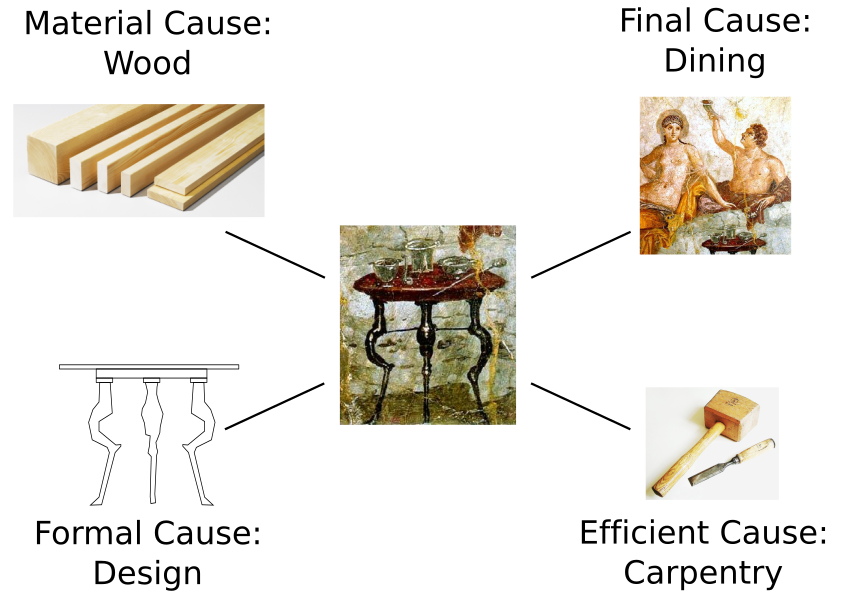

Science for the last five centuries has chosen to limit its toolbox only to tools measuring motion and tools that break things down into smaller and smaller parts. No wonder then that whatever any field of science dissects, becomes more and more of a messy pile of facts (and pulp and rubble, science is really good at turning things into pulp, rubble, and vague banalities) that are ever broken down further and further into fractionating sub-disciplines that are never reunited.
Of course, science has managed to do a lot, practically speaking, especially over the last two centuries, but it has turned from an open gaze at the world, for scientia (knowledge), and instead into a million little fiefdoms of people wearing welding goggles staring at only small pieces of the overall puzzle. A lot of this, of course, was Francis Bacon’s and Descartes’s intention in the shifts that they encouraged in science, as it turns out that, to a degree, ignoring the big picture gaze at nature and instead focusing on how to manipulate works. But we now produce machines, computer systems, and tools where no one understands how they work—nor, worse, how they affect us.
And we also have an ideological scientism that, oddly for an all-consuming ideology, can’t even give a unified account of the world. It can’t tell a story. Yes, there’s the Neil de Grasse Tyson or Stephen Hawking stories, the “the world is all atoms and randomness that somehow other things come out of that make other things story”, but that’s like all the other art and philosophy of modernity, merely a parody of stories, a pastiche with no real unity. No wonder then that universalism—the idea that no story is better than any story—is the self-destructive story inhering around us.
And so if we really want to understand the world, we’ve got to figure out how to unite the sciences (and the math that gives them surface unity) again.
What if I told you that the way forward for understanding the universe looks a lot less like the “atoms and the void” conception of many a secular academic and a lot more like what C.S. Lewis called the medieval vision, the “discarded image.”
What if that “enchanted”, musical, life-filled, human-centric, yet cryptically mysterious and transcendent worldview that we tossed aside five centuries ago was a lot closer to the truth than even it gave itself credit for? What if its real failure, rather than being too fanciful, was that it wasn’t imaginative enough, and that if we probed the question of why mathematics works so well, a new synthesis, a recycled image that looks a lot more like the Medieval vision than the way we would be—and maybe already is—emerging.
Part I: Rediscovery
The revolutionary, at least to the current scientific “consensus” ideas of Tufts University experimental biologist/philosopher Michael Levin, starting with his questioning the whole premise of dividing the sciences into separate fields, got my mind moving more clearly than I’ve ever yet pondered in the direction that the Medieval worldview might have been right after all. For Levin, dividing our attempt to understand the world into fields like physics, chemistry, and biology, while helpful in setting finite bounds for inquiry, has been making us blind to the real nature of the world.
Levin is known for his work in probing the miraculous qualities of embryogenesis, how living things come into being, and cellular behavior outside of their natural environments, his most famous discovery being cellular creatures called xenobots. He has interests and research across many disciplines and is particularly interested in the “blurry” boundaries between so-called disciplines. Reality, he posits, is a continuum, and sharply dividing it into distinct fields of inquiry makes investigating problems that exist in the boundaries between fields quite difficult. There is, he believes, a unified account of reality that we can find if we bother to look at the boundaries between our existing fields and disciplines. For Levin, this begins with actually probing the mystery of where mathematics comes from and why it works so well. Since even math/science can’t explain what causes its own patterns, they demonstrate must be more to the world than we can ever see:1
An empirical claim that I want to make strongly is this: we already know physicalism is incomplete, because engineers and evolution exploit many “free lunches” – patterns that are useful and guide events in the physical world but are not themselves explained, set, or modifiable by the laws of physics. This includes things like facts about prime numbers, Feigenbaum’s constants, and many aspects of computation. Nothing you do in the physical world, even if you can modify all the constants at the start of the big bang, will change those truths.2
This is Eugene Wigner’s observation about the “unreasonable effectiveness of mathematics in the natural sciences,” but whereas Wigner left the question open as a mystery, Levin attempts an answer: “there is a non-physical space of truths which we discover, not invent, and that this space has a structure that enables exploration.”
Math is in the world, but its patterns exist in some way independent of it since nothing you can do in the world can change 𝜋 or e or any of the other special ratios and patterns that we come back to again and again in reality, even in unexpected cases, like the synchronized periodical cicada mass emergence on 13 and 17 year intervals (both prime numbers)! The world must acquire these from elsewhere, so Levin proposes; perhaps this elsewhere isn’t an abstract imagination in our minds, but a real place, just not visible to us, even though we clearly, through our mathematical powers, have some sort of access to it.
For Levin, this space is not a place we access abstractly with our minds, like a number line or an imagined set of abstract grammatical tables, but is almost more real (or at least just as real) as the physical things around us:
Physical bodies don’t create, or even connect to (and thus have) minds – instead, minds are the patterns, with their ingressions into the physical world enabled by the pointers of natural or synthetic bodies. … [These] act as an interface to numerous patterns from this space of forms to which guide their form and behavior beyond what any algorithm or material architecture explicitly provides.
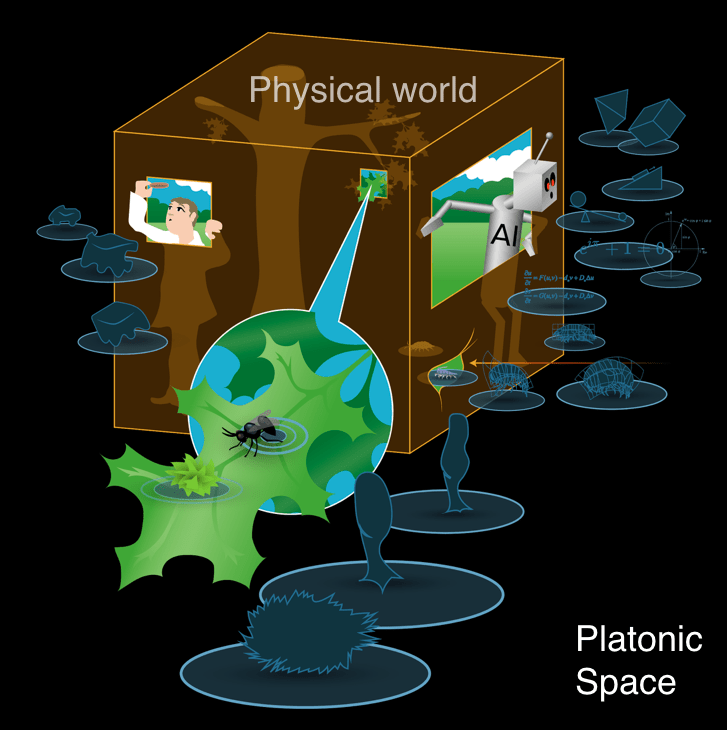

Since Levin calls this a “Platonic space” one thinks of Plato’s “realm of the “eternal forms”, but unlike classical Platonism, Levin conceives of this “realm” as something mutable, changeable, and part of our reality. Objects in the “physical” world are linked, correlated, or intrinsically turned toward to places in this “deeper” realm, a non-physical place of non-physical somethings, which causally interact with, or even “spill over” into “our” world, as he writes in this incredible paper:
Thus, a key pillar of the proposed framework is that the space of these forms is not haphazard or random but is a structured, ordered space that is amenable to systematic exploration. It is now essential to begin to map out the space, and to crack the syntax and semantics of the pointers – the mapping between the objects that we make in the physical world and the myriad of patterns that pour through those interfaces from the Platonic space (which I conceive of as being under a sort of positive outward pressure).
Human (and perhaps other, disembodied) minds for Levin are also a case of this “higher order” spilling over into the physical-spatial-temporal bounds of quotidian reality. We, as minded creatures, are part of this “higher” realm, and have direct access to it, he believes, and it’s what makes us capable of consciously perceiving reality’s mathematical nature:
Thus, I propose that minds, as patterns that ensoul somatic embodiments, are of exactly the kind (but not in degree) of non-physical nature as the patterns that inhabit and guide the behavior of simple physical structures. The relationship between mind and matter (of the brain for example) is proposed to be the same as the relationship between Platonic patterns and the physical objects they inform (or more accurately, in-form).
Our “minds” are to our “brains” as, in Aristotelian hylomorphism, the “forms” of things are to their “matter.” They are interconnected and essentially related, not completely distinct, but existing in a ratio or relationship as being to image or image to reflection. Save the word ratio, it will come back later!
Mind : Brain :: Form : Matter
It is this attunement that makes us capable, Levin believes, of much of our abstract powers of thought and comprehension of the world. We are a microcosm of the world at large, and, in our understanding of it, a reflexive mediator. Forms, the laws of nature, and other patterns are instantiated into physical reality from this “realm” and then reflected back into that realm by humans coming to see beyond their material instantiations to become knowers of the reality beyond them.
In other words, we’re talking about forms or souls here interacting with the world. Here, the Christian believer of today is comfortable—and maybe even bored. Ok, Michael Levin has come back around and rediscovered the soul. But Levin’s friend, philosopher Iain McGilchrist, commenting on Levin’s paper, pushes these ideas further, by proposing that with Levin’s “Platonic realm” must also return the concept of final causes, of teleology, that things in the world are driven not only by material forces but by purposes, ends, drives,
Aristotle might be a better guide, with his all-important idea of final causes – these are surely the goals towards which systems are drawn from in front – not impelled mechanically from behind: as you say ‘many biological patterns are goals the system pursues, not mechanical outcomes’. My conviction is that the whole cosmos has a drive towards bringing about something new, is creative, and in the process is not so much pushed forward, but drawn forward by purpose and values. It does not just push forwards regardless. There are lures, attractors, that ‘pull’ things forward. It is unfortunate that biology has been hobbled for so long by the need to deny both purpose and value, since these are an important part of the picture.3
Physical objects have purposes; they intrinsically exist for something. Not just living things, mind you, that clearly have minds and desires as individuals. No, all things pull ends, desires, purposes, or goals down from the “elsewhere” of the Platonic space, and for McGilchrist, this points toward everything being relational:
The importance of potential is vital. Everything is developing and changing, moving forward in the continuum of flow. You refer to the key question of ‘where these patterns come from’. To me the only way of seeing this that makes sense is that they are part of the purposes of whatever underwrites there being anything at all – namely the ground of being, aka God. I see that ground as being infinite potential, that is in a process of self-discovery by actualising itself. We are part of this process, a partner in a reciprocal dance, and we are different from inanimate matter only in the (vast) degree and nature of our capacity to respond, to reflect, to enable a resonant relationship with ground of being. Everything is relational. Nothing exists that is not a relation.4
We don’t typically think in such ways today, even as believers. Conditioned by very different relational forces around us and the Cartesian dualism that pretends a sharp distinction between mind and body, there is, for most of us, dead matter which is just “stuff” and then there’s the mysterious interior realm of the “mind” and the “self.”
Levin and McGilchrist’s views of “Platonic Space” and a “teleological” universe, in contrast, subvert the hard distinction between matter and form or body and mind. Their view of physical bodies as interfaces with deeper realities to which they are united, or merely one aspect of beings who are more than the sum of their parts, and every being being relationally part of a “cosmic dance” would have been uncontroversial to the Medieval, who saw things, perhaps with less precision, but definitely more wholistically, with beings, living and non-living alike, having purposes, even motives, a vision of the world that’s more like the repeating blend of simplicity and complexity in the fractal patterns of mathematics.
And if mathematics itself is part of a physical realm of “patterns” that have an active effect on the world and on eachother, and its effectiveness in our material realm is because the world’s order is a shadow of this higher order, Levin pushes his ideas a step further so as possibly even to include entirely disembodied beings affecting the world through their affecting the “Platonic realm”
Another door that is opened by the marriage of Platonic space with diverse intelligence spectra is the consideration that while observable, active patterns must be embodied, it is the patterns themselves that can often be seen as the agent.5
In other words, we would say, angels and demons…
My recent thoughts on such beings and their relationship to ideas and physical reality:

Medieval scholar Robert Keim of Via Medievalis recently summarized a view similar to Levin’s, where perhaps even the current paradigm regarding matter and energy points to our bodies, and all material things, being “crystallized energy” or energy/potential that is held together by form:
An American physician and researcher named Thomas Cowan, compelled by the 2020 plague to reflect deeply and persistently on the nature of disease, proposed in a thought-provoking essay that “we’re all crystallized energy. That’s the only way to say it.” A fringe idea if ever there was one—right? Maybe so, but the problem is that his conclusion follows logically, almost inescapably, from ideas that mainstream science now accepts and promotes. These ideas are that 1) atoms are mostly empty space; 2) an atom’s electrons are both physical particles and energetic waves; and 3) the human body (and every other material entity) is built entirely from atoms—that is, from atomic nuclei surrounded by empty space influenced by electron energy. “This,” Cowan says, “is how physicists describe the nature of reality.”
But energy, by definition, is not a discrete material object, and therefore it does not have physical boundaries. Rather, energy has a strong tendency to move from one object to another: heat diffuses into a room, sound waves travel through the air, radiation propagates into space, electricity flows from a source to a load. Thus, Cowan goes further: the human body, as a fundamentally energetic structure, is inseparable from “energy forms that presumably circulate all around the earth. We’re all connected—that’s what the physicists are telling us. We’re all crystallized energy.” If you don’t like the sound of this, I understand. But I insist, with some discomfiture, that his statements are not far-fetched if you accept scientific principles that now are so conventional as to be taught in an undergraduate physics class.6
While Thomas Cowan, whom Robert Keim is quoting, may be a bit more “fringe” in his research, his conclusions merely restate the ideas of Levin and McGilchrist, established and credentialed research ideas, in more poignant terms.
If we dared to look, that is, opposed to the stultified state of modern scientism’s dogmatism, dead set on perpetuating the line that the world is meaningless, boring rocks made out of boring blobs, that-may-or-may-not-be-made-out-of-anything-but-please-just-keep-paying-us-to-work-on-string-theory-forever…—maybe we’d find something different.. Just as occurred with the transition from Newtonian to Einsteinian paradigms, the World is far more ordered than the current models, and each scientific regime fails and needs replacement because the model is just too small, too clunky, too ad hoc, and has too small an imagination.
For Levin and McGilchrist, the world, like the old adage, is turtles all the way down (and up), fractals on top of (and below) fractals, complexity in every direction, but ordered complexity. The world is a nested hierarchy of realms of varying immateriality, each filled with beings, laws, and principles, each governed by some other principle above them and each unifying those below them. As Mark Bisone, writing on McGilchrist puts it:
Just for the next few minutes, adopt the premise that the universe isn’t quite as fragmented, meaningless, and mundanely explicable as often it seems to be. Instead, imagine that it’s a place where patterns reiterate at every scale and resolution, a realm of fractals and butterfly winds. In this place, we are minds, first and foremost, with patterned structure generated as a byproduct of energy exhaust. And by “we”, I mean everything that exhibits intelligence, from nations down to nanoparticles. The patterns differ slightly based on many factors, but we can still detect their shape almost anywhere we look.7
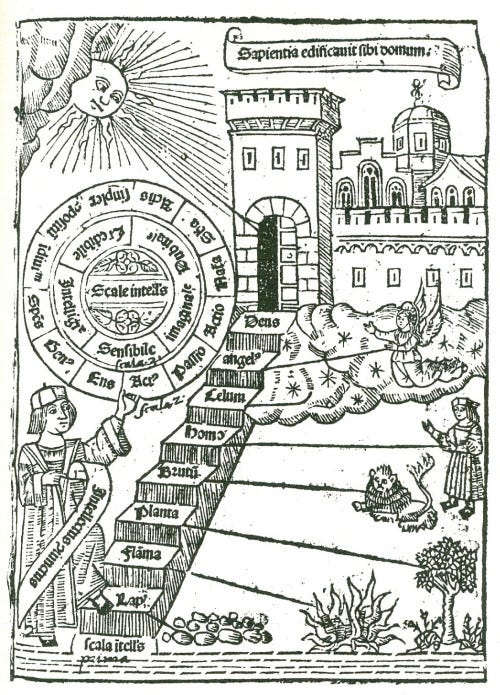
For the Christian, this is the kind of thing we would expect in a created world, and Bisone/Levin/McGilchrist sound a lot like the Medieval Model of the Great Chain of Being, but one, this time, that due both too all the discoveries over the last centuries and the whole lot more that we also don’t yet know about,8 is a little too complex and perfect to fit into a human drawn sketch:
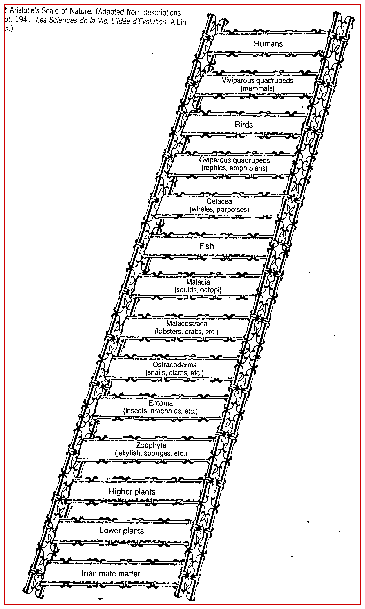
And what if that vision, that seeing anew, rediscovery of certain aspects of the Medieval/Classical worldview of what the world is, has been right before our eyes the whole time?
Part II: The Recycled Image
The Cosmos
Let’s do some thought-crime and restore a sense of wonder at some aspects of the world that we might have missed.
For one, how do we know that the Earth is, as modern science tries to tell us, just a random speck floating in a humdrum part of the universe?
Even if we accept the modern consensus, if you draw an image of the universe logarithmically and looking back into time (as in fact looking into space is) we get a very different perspective, concentric spheres, with the Beginning, the Creator giving motion to all things (Aquinas’ First Way) at the edge and giving motion (as in the Medieval vision) to the spheres within and closer to us:
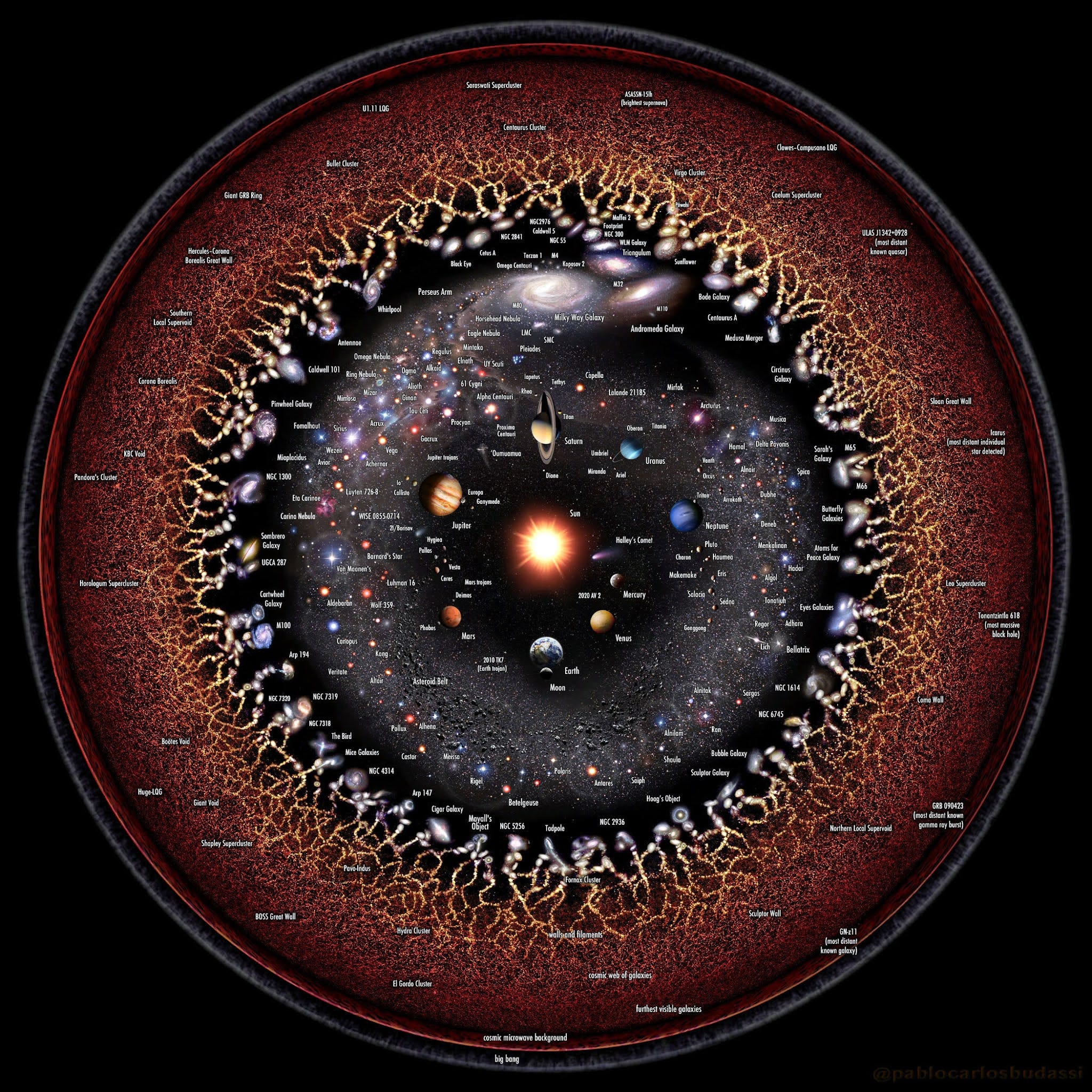
To be true, this universe is quite a bit larger and less cozy than the old one. It is, as WCC professor Dr. Scott Olsson points out, better at pointing out that the universe itself is not God, but merely His creation. It is a sign, it points to Him who in His infinity cannot be comprehended or contained even by the immensity of 65 billion (or 10^10^500 more than that) light-years
In this synthesis, I believe I’m seeing that, while the old system felt saturated with God, the new model emphasizes his radical transcendance. We will be shocked to find that God became man. The old cosmos bordered on a home for God, while the new cosmos is a monument imitating him. Its purpose is to point to him. For it to be an effective sign, we have to encounter it. The universe can’t do its job if we can’t know it.
In fact, when I look at this image, I see more than just a map of the universe’s past and vastness in time and space. No, instead I see an image, a model, of an eye, a created image of the Divine knowing of itself, the logos/Word/Son the created world being an image of the eye of the Word.
Side Tangent: It’s also not entirely clear that “science” is settled on the “purely” heliocentric/the-earth-is-randomly-in-the-most-unimportant-non-special-part-of-the-universe-view. See the movie The Principle here. And no, I’m not totally sold on it, but I don’t find it to be completely crazy, especially with how ideologically captured all the other even more eminently testable fields of science have been over the last few decades.
But I won’t force that part of the vision on you. It would just make the previous points even stronger:
But what fills the vastness of the universe?
Well, galaxies that flap their wings to start (along with 95% of stuff being things we can’t see and can’t even pretend to understand), along with all the other weird stuff we only kind of do:
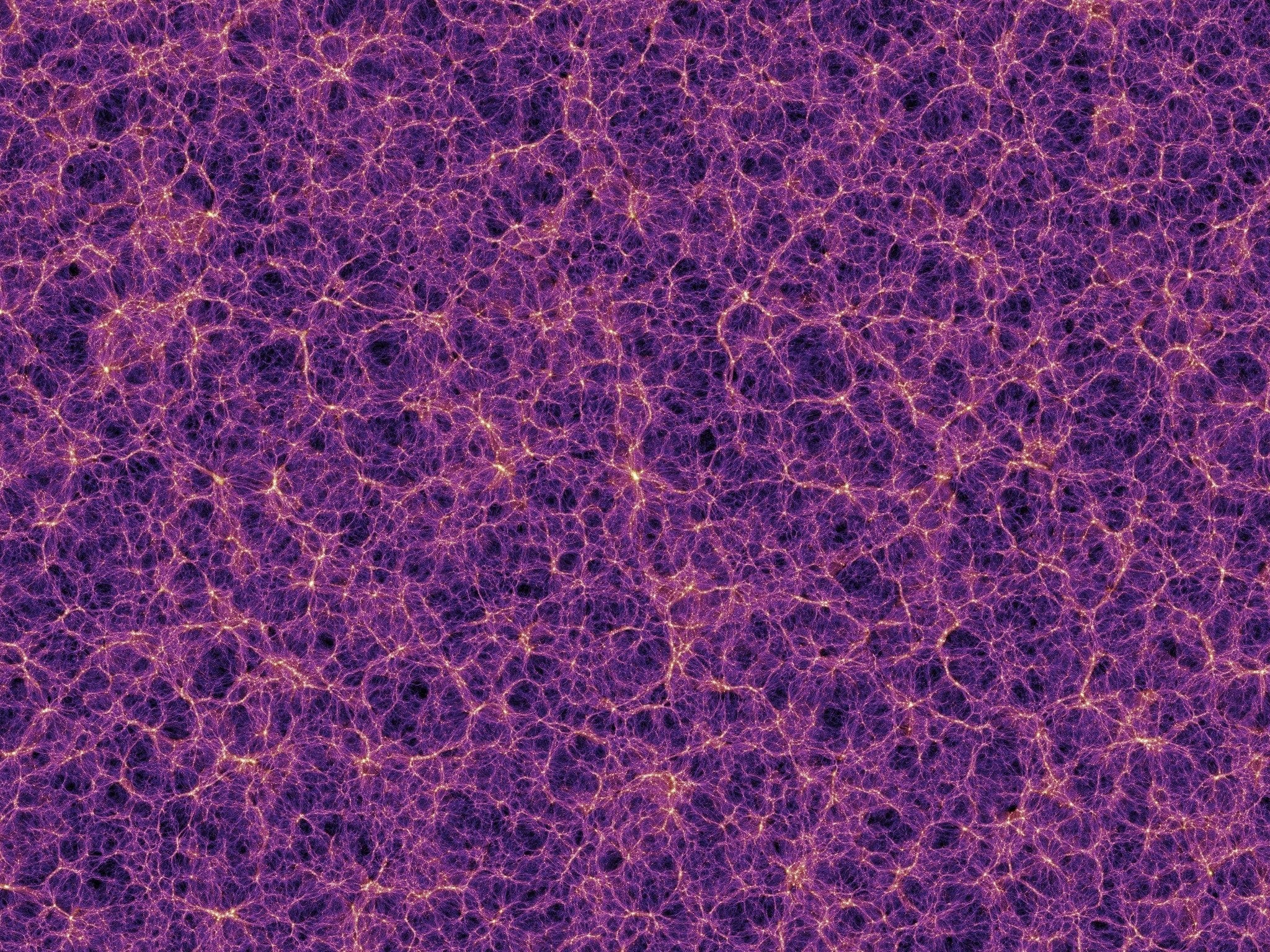
Looks a little like the structures of the brain, doesn’t it?
But let’s zoom in a little on things that are at least slightly comprehensible.
How about stars and planets that aren’t just random piles of dirt, gas, ice, and rock but active agents, forms unifying matter, or patterns crystallizing energy (take your pick of metaphors), with active roles to play in Divine providence? Or as C.S. Lewis put it in literary form: “Even in your world, my son, that is not what a star is but only what it is made of…” 9
The Stars
This one is out there, but stems from the fractal patterns, nested hierarchies, that we keep on finding in the universe, and that one (very speculative when it comes to stars) philosopher summarizes here:
In the light of the philosophy of organism, everywhere we look in nature, at every level and scale, we find wholes that are made up of parts, which are themselves wholes at a lower level: for example crystals are made up of molecules; molecules of atoms; atoms of nuclei and electrons; atomic nuclei of protons and neutrons, and protons and neutrons of quarks. Or ecosystems are made up of organisms; organisms of organs; organs of tissues; tissues of cells; cells of organelles; organelles of molecules… Or galactic clusters made up of galaxies; galaxies of solar systems; solar systems of stars and planets. Languages have the same kind of organization: sentences made up of phrases; phrases of words; words of syllables; syllables of phonemes10
What if the stars, as is argued here, are alive and have some level of sensation through and control over their electromagnetic fields and solar flares, and can even use jets of plasma from their poles to shift their location around their galaxy to consume gas for continued nuclear combustion?
Sounds crazy, but as technically can’t disprove it, especially if their sensation/experience is over far longer time scales than those we’ve grown accustomed to.
There actually are arguments for this conclusion.
For one, are or are not stars distinct things?
For the serious philosopher, this is actually a tough question. Is a star a substance, a distinct, unified thing with a specific form, boundaries, properties, and new qualities that its mere constituent parts do not have?
Or is a star merely an amalgamated pile of matter, and the real “thing” here just a bunch of hydrogen gas?
Choose the first, and you can’t really say that stars exist, but rather that stars are merely names we give to certain incidental piles of matter with no intrinsic unity.
Choose the other, calling stars substantive wholes, means giving them a form, a principle of unity that gives the whole new capabilities and powers not present in any of the individual parts that make it up.
And certainly the latter position seems more credible, especially with all of the complex characteristics of the efficient process of fusion in stellar atmospheres and the sun’s magnetic field, making it, and the solar system, appear to work as one, interconnected whole that is also capable of sustaining its order despite obstacles and interference.
There’s also a literal wall of hydrogen plasma at 54,000-90,000 degrees Fahrenheit created by the sun’s magnetic field that divides the sun’s region from what is without (also incidentally protecting the Earth from interstellar radiation.
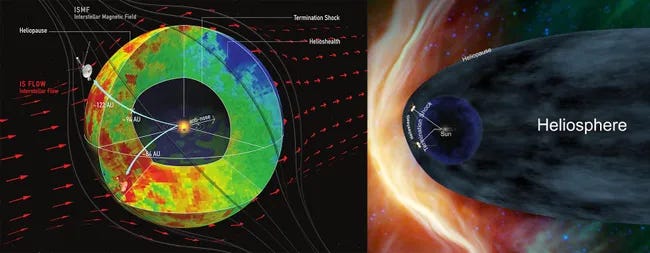
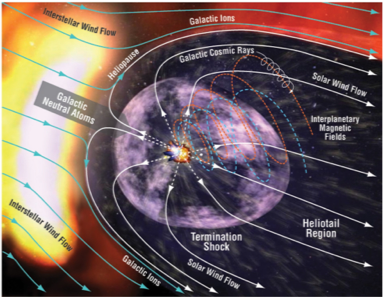
But the best argument for there being something more to the sun, outside of Levin’s idea of patterns (forms) being prior to me, admittedly soft, is just that God creates things with a purpose, and it seems like a weird waste if the largest, most visible objects are the least active, least real, and most dead. And the Medievals, as we will return to in a bit, didn’t see a problem with stars being heavenly intelligences (beings) with influences over the world.
And there’s even some interesting speculation about the jets that certain stars produce from their poles, pointing in non-random directions and enabling—get this, stars to accelerate and move themselves through space. As Lewis, again in literary form, of course, but in a line meant to tease us toward actually thinking about it, wrote, perhaps there’s more to what stars and (all things) are than merely what they’re made of:
“Even in your world, my son, that is not what a star is but only what it is made of…”
Certainly, at least, the sun’s energy, obviously, also has a teleological, purpose-driven role for the existence of human life. And within the solar system, at least, it also has, as Genesis tells us, a role of governing the system, as we’ll see by looking at the planets next.
The Planets
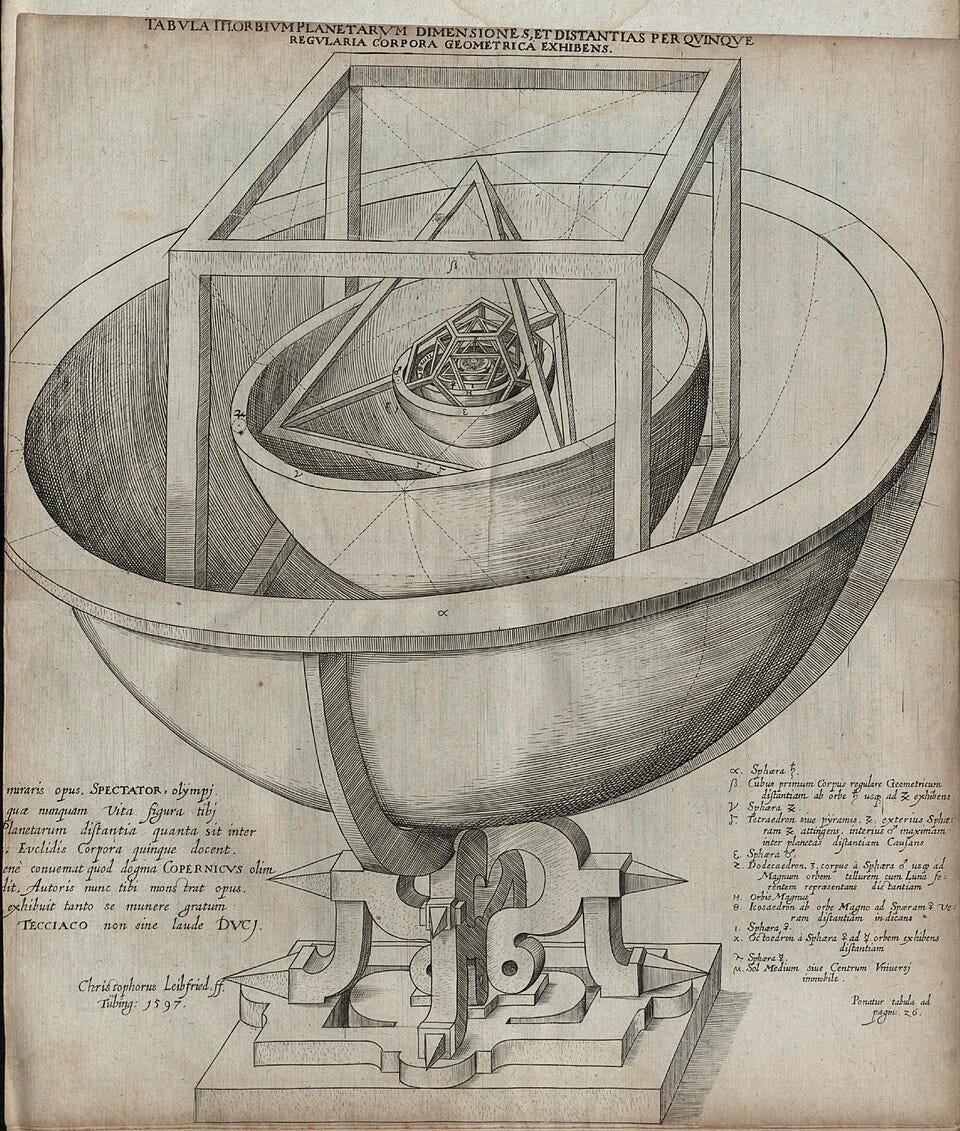
Johannes Kepler is famous for his study of the planets, discovering the three laws of planetary motion that laid the groundwork for Newton’s more abstract and universal laws of motion.
But what’s lesser known is the model of the solar system that Kepler attempted to work out first in his book Mysterium Cosmographicum, one where the motions and behaviors of the planets could be described by the relationships between the perfect (or Platonic solids), the cube, tetrahedron, octahedron, dodecahedron, and icosahedron. The ratio of the orbits of each planet corresponds to one of a series of such centric shapes inscribed and circumscribed about each other and about spheres.

As John Psmith explained, Kepler’s first guess in Review: Lectures on the Icosahedron:
For each of the Platonic solids, you can imagine blowing a balloon inside of it until it just touches the faces of the solid, and also slowly deflating a much larger balloon around it until it just touches the vertices. The ratio of the radii of the inner balloon and the outer balloon is the same no matter how big or small the solid is, it’s just a fundamental property of that solid.
Now, the imaginative leap: Kepler noticed that these ratios are the same as the ratios between the orbits of successive planets in the solar system (well, sort of). The conclusion practically writes itself: the Ancients were correct that the Platonic solids make up everything, but overly literal in their application. It isn’t that fire is literally made up of tiny tetrahedra, but rather that the tetrahedron and its siblings govern the motion of the planets and the harmony of the heavens. Given the accuracy of the telescope technology available to Kepler, the model actually fit very well (you can play around with it on this website). We should consider ourselves lucky that Kepler leapt to this conclusion, because it was in trying to work out the kinks in this theory that he formulated his laws of planetary motion.11

View a visualization of Kepler’s model here
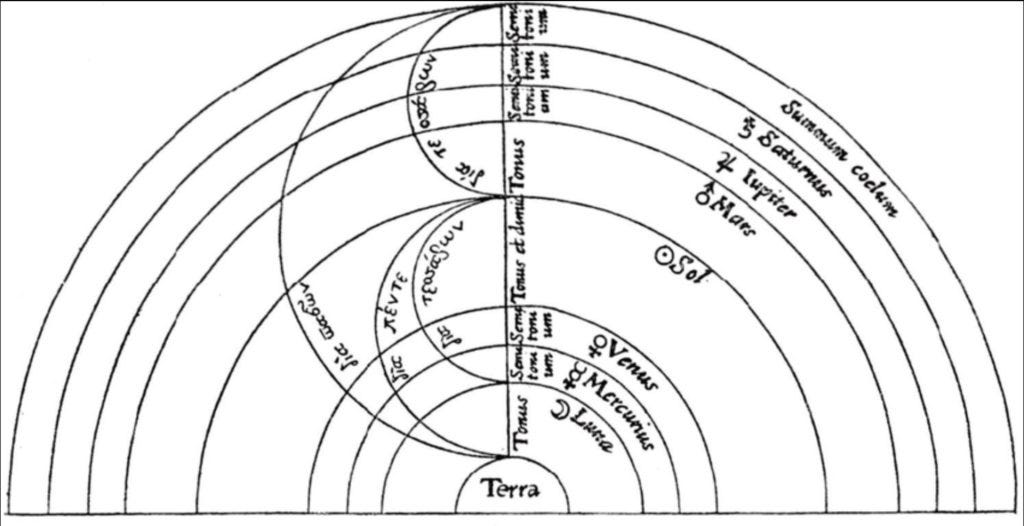
Kepler’s work on the solar system is interesting for another reason. Through further finagling, and expanding on Pythagoras’s (that one!) ideas about the planets moving in their heavenly spheres creating music called the “harmony of the spheres”, found that the planets’ orbital speeds at their perihelion and aphelion, their closest approach to and most distant point from the sun, respectively, create ratios equivalent to certain musical intervals, which he described as polyphonic harmonies in his work Harmony of the World:
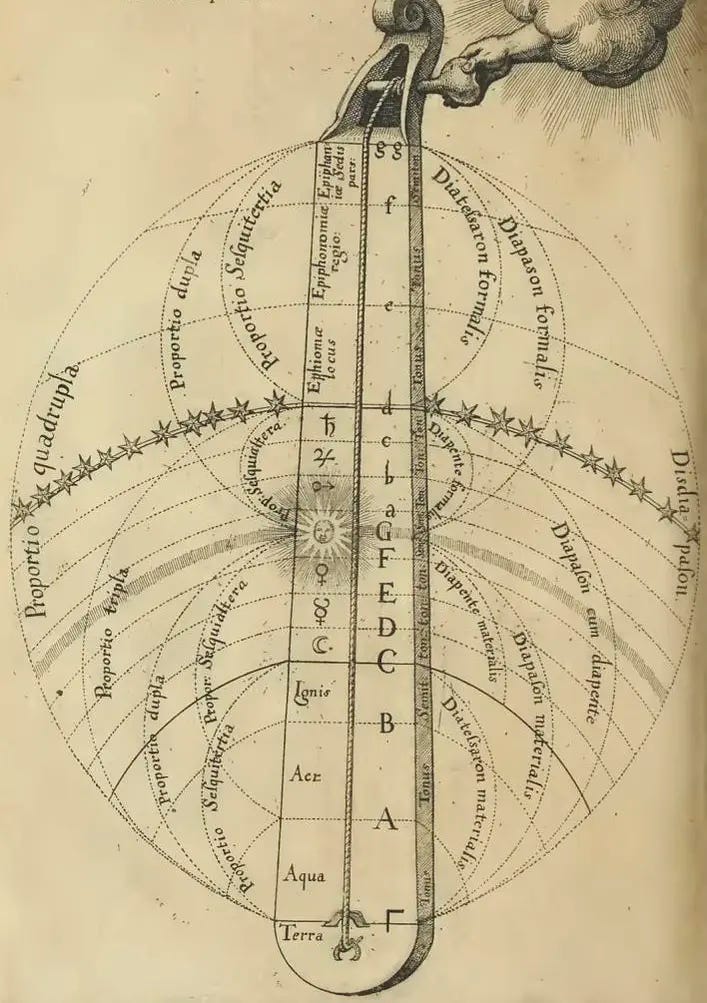
The movements of the heavens are nothing except a certain everlasting polyphony (intelligible, not audible) with dissonant tunings… which marks out and distinguishes the immensity of time with those notes.12

Looking back, Kepler’s ratios, like the 3:2 of the Perfect Fifth, the 4:3 Perfect Fourth, etc., don’t seem to be as perfectly in the world as he had mapped, but maybe, as John Psmith noted, we’re again taking things too literally and not seriously enough.13
That the planetary orbits fit in inscribed perfect solids could be a meaningless coincidence, and so also could the musical ratios, but another interesting pattern of orderly order, Bode’s Law, remains, as I’ll let Encyclopedia Britannica explain:
Bode’s law begins with the sequence 0, 3, 6, 12, 24,…, in which each number after 3 is twice the previous one. To each number is added 4, and each result is divided by 10. Of the first seven answers—0.4, 0.7, 1.0, 1.6, 2.8, 5.2, 10.0—six of them (2.8 being the exception) closely approximate the distances from the Sun, expressed in astronomical units (AU; the mean Sun-Earth distance), of the six planets known when Titius devised the rule: Mercury, Venus, Earth, Mars, Jupiter, and Saturn. At about 2.8 AU from the Sun, between Mars and Jupiter, the asteroids were later discovered, beginning with Ceres in 1801.14
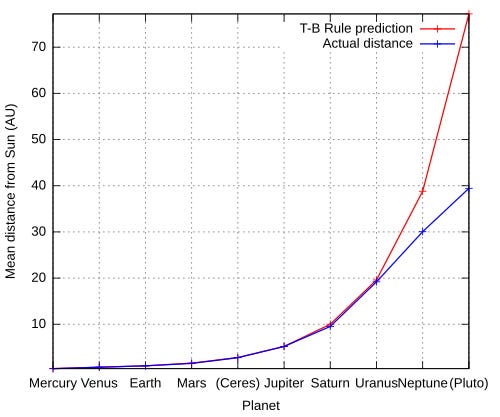
Is this orderly distribution of planet locations a coincidence? Some say so, but with similar, non-random patterns having been discovered between the distances of Jupiter’s moons (and discovered exoplanets) in Michael Levin’s approach, there’s at least some sort of pattern here. Whatever lies beyond the physical world, which gives us our mathematics and science, is showing us something that there’s more than mere chaos in the relationship and interactions between the planets, or what some scientists, without much description, call spontaneous harmonic orbital resonance. Kepler and Pythagoras’s vision of harmonic order is resurrected, if not in fact, at least in spirit, and at a deeper, more fundamental level.
The Laws
Gravity is not merely the type of thing that pulls things together randomly. Rather, whatever it is (more to come), it is set up or ordered for the creation of harmonic order. It is ordered for order.
Ordered mathematical patterns work so well to model the physical world because the order in the physical world is but a shadow of a more symmetric, more ordered mathematical (or otherwise immaterial) realm from whence its order comes. The universe is rational; it is made with and through, and it arises out of ratios and relationships.
But what is the gravity that is typically thought of as the primary cause and determiner of this order? For all our everyday experience with it, mystery nevertheless remains. We can describe its effects, but our formulas give us no model of why. Things fall because they do. We must, as Richard Feynmann in his The Character of Physical Law lectures, argued, choose between models of what is going on, between gravity as objects calculating the mass and distance from themselves to other objects and determining how to react, gravity as a force or field exerted outward from each object onto every other (action at a distance), or gravity as each object mapping out possible paths through space and choosing the one that requires the least action (or over which kinetic energy minus potential energy is least).
All of these are philosophically weird to our current imagination of inanimate beings and inanimate forces, but not so to the holder of a teleological worldview. For Aquinas, the rock falls because of an internal principle of motion. It wants to seek its natural end. Gravity and the other forces, the laws of nature, are the working out of the desires (and goal directness) of each being.
More on reorienting science here:

I am not claiming a panpsychism that all is mind, or that all atoms are conscious, or the like. It is actually, as many have noted, a greater anthropomorphism to claim that objects and beings follow laws than to say, as Aquinas did, that they have (limited) desires, and try, as Michael Levin, in his interviews, says he sees again and again in nature, beings (patterns) of all levels and types trying to reach certain ends, including ends and goals in a “space” that transcends material reality.
BUT WAIT… If beings can have goal-directedness and desires and exist for the sake of particular ends, let’s now look at the planets themselves with a new eye.
What are their purposes? What are they for?
The Effects of the Planets
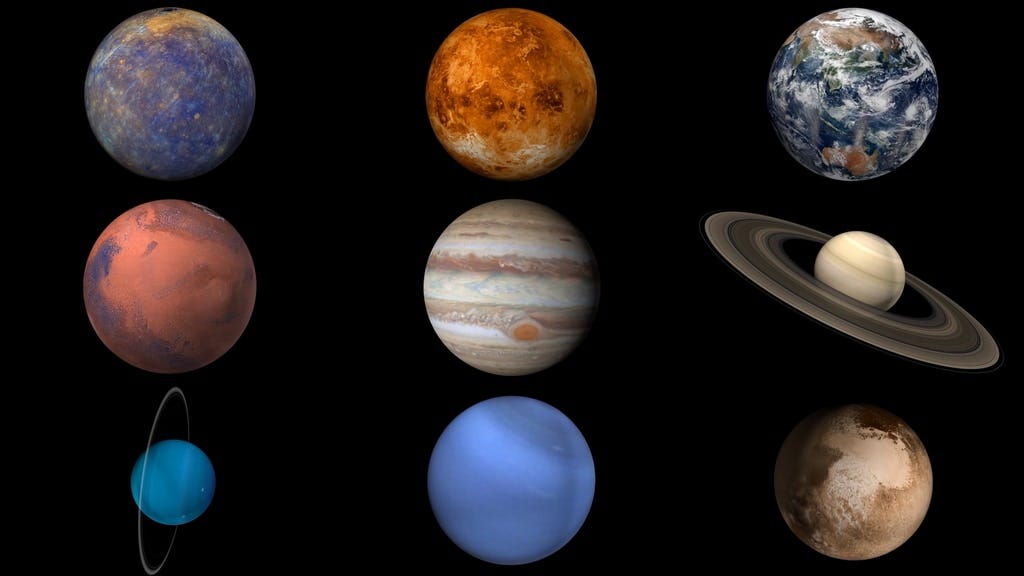
We all know the planets don’t affect us, right? That’s crazy talk. That’s uhh, astrology to claim that they impact the earth or affect human behavior.
But what if they actually do affect us? And of course, if we really think about it, we already know they do.
The Sun and the Moon, through tides, for example, lift and lower the water level of the Earth several feet. So do the planets. They’re pulling on us now, literally. And even if we can’t feel their effects, they are affecting us. Changes in the sun’s energy output and gravitational effects of the planets on Earth’s tilt and orbit* (*pending confirmation) affect the climate over extended periods of time.
Making these claims, or even to go further and suggest psychological effects caused, for example, by the phases of the moon, eclipses, etc., is not of itself divination or astrology. What is wrong is to claim that the celestial bodies (or angels/demons) control us. As C.S. Lewis explains and defends the medieval perspective, which strongly believed in such influences, in The Discarded Image:
Astrology is not specifically medieval. The Middle Ages inherited it from antiquity and bequeathed it to the Renaissance. The statement that the medieval Church frowned upon this discipline is often taken in a sense that makes it untrue. Orthodox theologians could accept the theory that the planets had an effect on events and on psychology, and, much more, on plants and minerals. It was not against this that the Church fought. She fought against three of its offshoots.
(Against the lucrative, and politically undesirable, practice of astrologically grounded predictions.
Against astrological determinism. The doctrine of influences could be carried so far as to exclude free will. Against this determinism, as in later ages against other forms of determinism, theology had to make a defence. Aquinas treats the question very clearly. On the physical side the influence of the spheres is unquestioned. Celestial bodies affect terrestrial bodies, including those of men. And by affecting our bodies they can, but need not, affect our reason and our will. They can, because our higher faculties certainly receive something (accipiunt) from our lower. They need not, because any alteration of our imaginative power produced in this way generates, not a necessity, but only a propensity, to act thus or thus. The propensity can be resisted; hence the wise man will over-rule the stars. But more often it will not be resisted, for most men are not wise; hence, like actuarial predictions, astrological predictions about the behaviour of large masses of men will often be verified.
Against practices that might seem to imply or encourage the worship of planets—they had, after all, been the hardiest of all the Pagan gods. Albertus Magnus gives rulings about the lawful and unlawful use of planetary images in agriculture. The burial in your field of a plate inscribed with the character or hieroglyph of a planet is permissible; to use with it invocations or ‘suffumigations’ is not (Speculum Astronomiae, X).
Despite this careful watch against planetolatry the planets continued to be called by their divine names, and their representations in art and poetry are all derived from the Pagan poets—not, till later, from Pagan sculptors. The results are sometimes comic. The ancients had described Mars fully armed and in his chariot; medieval artists, translating this image into contemporary terms, accordingly depict him as a knight in plate armour seated in a farm-wagon—which may have suggested the story in Chrétien’s Lancelot. Modern readers sometimes discuss whether, when Jupiter or Venus is mentioned by a medieval poet, he means the planet or the deity. It is doubtful whether the question usually admits of an answer. Certainly we must never assume without special evidence that such personages are in Gower or Chaucer the merely mythological figures they are in Shelley or Keats. They are planets as well as gods. Not that the Christian poet believed in the god because he believed in the planet; but all three things—the visible planet in the sky, the source of influence, and the god—generally acted as a unity upon his mind. I have not found evidence that theologians were at all disquieted by this state of affairs.
For the Medieval, as Aquinas was but one example of a theologian who held such a view as those Lewis was describing, the planets were beings of some sort and also served as signs. They had physical effects on the world that effected that which aligned with what they signified. They “move and govern lower bodies”15 and are a cause of motion and change in things below on the Earth. Of course, it’s dangerously close to superstition to be overly interested or to start governing your life by their behaviors. You’ll be giving other intelligent and devious beings power over you by your belief.

But even the most secular, materialistic science has to believe in gravity, and gravitational effects, even in that view, let alone viewing gravity as objects responding to their innate natural desire to be near one another, force us to admit that there’s some impact of the heavenly bodies upon us.
For one uncontroversial example of the heavenly beings serving as signs, the stars and planets heralded the arrival of their great King, and The Star of Bethlehem movie makes great arguments for their identity and symbolism.
While I love Rick Larson’s discoveries and theories in the movie, I actually quibble with one part of this worldview.
Many have marveled at Jesus’ statement—that God’s “mind” is so great that it allows his complete familiarity with the creation in all of its detail. We can barely begin to contemplate it. But confronting the Star, we see the same message.
For if the Star wasn’t magic or a special miracle from outside of the natural order, then it was something even more startling. It was a Clockwork Star. And that is overwhelming. The movement of the heavenly bodies is regular, like a great clock.
The Clockwork Star finally means that from the very instant at which God flung the universe into existence, he also knew the moment he would enter human history in the person of Jesus of Nazareth. He marked it in the stars. And from before the beginning of time as we experience it, God knew the very moment when Messiah would breath his last on the cross.16
Larson, like all of us, has adopted the current scientific consensus and imagination wholesale. The universe is clockwork. There is a certain grandeur, yes, to this view of Divine providence. But there is a greater grandeur, is there not, in the motion, ends, and major catastrophic events involving heavenly bodies coming from internal principles of motion and rest within them? That they are beings which seek, intrinsically, to fulfill the good of the whole and the will of their creator?
With the inherent mystery of gravity, there is no reason not to think this. And if all things move by such internal principles, according to patterns that they receive like Levin’s “free lunches,” then we have not merely Larson’s “clockwork universe” but as Aquinas argues, almost a living universe, like Dante’s universe of spheres moved internally by love:
So, therefore, in the parts of the universe also every creature exists for its own proper act and perfection, and the less noble for the nobler, as those creatures that are less noble than man exist for the sake of man, whilst each and every creature exists for the perfection of the entire universe.17
In such a vision, the stars and planets are not random piles of dirt, gas, ice, and rock but active agents in Divine providence and human history, fulfilling the role of being a place for man, and a tabernacle for God Himself to enter.
Each of the planets, it could actually be argued (some of my connections are unfinished), served (and still serves) a particular role in creating man’s abode. (I’m presuming standard scientific orthodoxy here, which I’m not set on, but this is all to show that even with “modern” science, we can’t escape the conclusion that things are set up in a rationally ordered and inexplicable way that leads us back to the discarded image).
Mercury and the moon, for example, are likely the two remnants of a collision that formed Earth’s interior plate tectonics, and therefore our geography, while also giving us certain of earth’s minerals that we wouldn’t otherwise have, with chunks of it still beneath Africa and the Pacific Ocean. Without these, we wouldn’t have the tides—nor an overall stable climate, and I can’t help but ponder that could have been something to the Medieval view of Mercury as the planet of profit, giving us much of the world’s silver/gold:
Mercury produces quicksilver. Dante gives his sphere to beneficent men of action. Isidore, on the other hand, says this planet is called Mercurius because he is the patron of profit (mercibus praeest)’,18
Mars, meanwhile, affects the earth’s deep ocean currents while Venus and Jupiter, affect the earth’s climatic cycles at times even as Jupiter increases the overall stability of the planetary orbits and reduces the number of collissions that would be suffered by earth, not entirely disconnected from the Medieval imagination’s connection of the latter two to, for Lewis, “beauty and fortunate events” and “halcyon days and prosperity”, respectively.
These are first sketches, a few of the less speculative effects of some of the planets (I have more possibilities catalogued). The point is not to push astrology, but merely to show that the universal idea of planets affecting the earth and us is not completely crazy. The discarded image of the Medieval model may have been off in details, but it was right in generalities and principles. And the Medievals, unlike our current ages, would have agreed, as Lewis argues in The Discarded Image, that their model was provisional:
I hope no one will think that I am recommending a return to the Medieval Model. I am only suggesting considerations that may induce us to regard all Models in the right way, respecting each and idolising none. We are all, very properly, familiar with the idea that in every age the human mind is deeply influenced by the accepted Model of the universe. But there is a two-way traffic; the Model is also influenced by the prevailing temper of mind. We must recognise that what has been called ‘a taste in universes’ is not only pardonable but inevitable. We can no longer dismiss the change of Models as a simple progress from error to truth. No Model is a catalogue of ultimate realities, and none is a mere fantasy. Each is a serious attempt to get in all the phenomena known at a given period, and each succeeds in getting in a great many. But also, no less surely, each reflects the prevalent psychology of an age almost as much as it reflects the state of that age’s knowledge. Hardly any battery of new facts could have persuaded a Greek that the universe had an attribute so repugnant to him as infinity; hardly any such battery could persuade a modern that it is hierarchical.19
For Lewis, our choice of models is not merely determined by the facts. Our temperament and biases move us toward or against details, with the key fact today that science is loath to accept being the hierarchical and teleological, life-filled aspects presented by such a recycled image that depends upon a transcendent world beyond it.
But the transcendence of Levin’s own Platonic realm still demands an explanation for itself. What is it and where does it come from?
Part III: The Equation At Infinity
The Mustard Seed
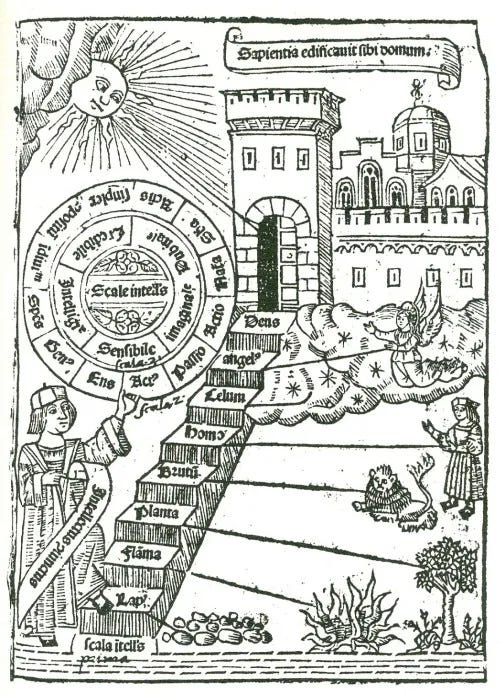
Returning to one part of the medieval vision, that of the hierarchical chain of being, gives us one reasonable possibility. The “Platonic Space” that Levin has “rediscovered” would have been considered to be the interactions between certain of the beings “above” man, set by God to govern that which He has created. But there is a hierarchy amidst these, the angels, as Dionysus the Areopagite) and most of the Medievals thereafter believed, a chain of causality that stretches to higher and higher powers. Corresponding to each level, and between the levels, there is interaction, communication, and we could call whatever non-material space these interactions take place in “the levels of the celestial hierarchy, or the level of “Platonic space.”
The world is thus, as I’ve argued before, hierarchical all the way, fractals all the way to infinity.
The chain, of course, can’t go on forever. The created world is held in existence by the Creator at the top, with the activities of the angels in the middle, but above us, while, at the bottom, below the lowest being, lies absolute non-being, that-which-is-not. And the average physicist, for all his probable stuffiness and materialism, agrees with the Medieval. There is some reason, some ratio/Logos lying causally primal to the world, and there is, on the other end of the rope, nothing smaller and simpler than the smallest particle (besides maybe the potency and fuzziness of the quantum foam).
Or as Iain McGilchrist (commenting on one of Levin’s publications) puts it:
You draw attention to the ‘remarkable and beautiful (also life-like) pattern seen in the Halley plot kinds of fractals. That entire highly specific form is encoded in the very simple formula in complex numbers, and can be revealed by a simple algorithm. The fact that this highly complex pattern is indicated by a very short description of a function provides an un-ending richness from a small seed.’ For me this word ‘seed’ underlines two important points: one is that of potential, which is crucial: the potential for beauty and complexity within what appears simple. I consider this a perfect example of a cosmos creatively unfolding its potential. And the second is that this potential discloses beauty and order, not valueless chaos. You several times refer to ‘patterns that ingress in a way that results in getting more out than we put in’: I think this expresses exactly this fulfilment of potential.20
The orderliness, the goal directness, the behavior, knowledge, action, and loves of the beings of the world cascade down through this chain like a waterfall or the growth of a plant from a small seed (I can’t help but think of a mustard seed) that unfolds more and more in every direction.
What is the highest level that produces all the governed, teleological order? What holds the world together, at each level, and as a complete system? Where, to ask my first and opening question, does mathematics (and everything else) come from?
There’s only one word that fits the bill: ratio.
For us today, too often the word ratio carries the dry connotation of number. We express them as decimals and manipulate them in equations so much as to forget their original connotation: relationships. Ratios are relationships between two beings (or abstractions thereof).
All of mathematics could be summarized as understanding how to preserve a ratio of oneness while also pondering how oneness relates to infinitude, geometry is about how the infinitely small and simple (a point) relates to itself, and even calculus is just about figuring out how to transcend finitude and approach a reality that is present, ordered, and simultaneously always just beyond reach.
All of science is about trying to understand the ratios or relationships between beings.
And all of metaphysics and—in the end—theology—is about coming to know that Ratio, or Logos, or Word through which the whole chain was created and renewed.
And what is the world itself for?
The World As Equation
For starters, as a commentator on one of my articles named JC, reminded me, the temporal perspective on space and time is not the only one. God has the full picture of Creation, and we don’t.
For us, trapped in a creation of limited dimensions, we perceive time and events linearly. The Creator is not so limited, and has already completed creation--including the work of the Holy Spirit and the astonishing intervention of God’s own heir, His ultimate demonstration of love. Thus the Son was slain from the foundation of the world, but the entire creation must be run forward from our perspective; the math has to be calculated in steps, even though the answer is known.
For God, the world is a completed “work”, like a math problem whose answer, the “glory of God”, is already known from the eternal perspective. From the temporal one, in time, however, the individual mathematical steps still must be performed, one at a time, before the final fullness of time for the Second Coming is completed.
One thing about our perspective that’s both interesting and constraining is that we’re in the “middle of the map”, logarithmically speaking, with respect to space and time. We can’t easily comprehend small or large sizes or timescales, experiencing and noticing only those things which happen over time scales and size scales that are “just right.”
And since we’re, as Michael Levin also frequently points out, “mind blind” to those things which don’t easily fit our quotidian imaginations, this explains why we often miss the causal agency of the beings in the universe reaching back to their Creator in love. They play out on different timescales. Except sometimes in retrospect, we can’t notice the impact of Providence on time scales larger than our short-term memories, let alone longer than our lives.
Furthermore, whatever the true age of the universe is, it doesn’t matter to its and our dignity. The world (and mankind) is in the image of God because it is in the image of the Word. Inasmuch as its constituent parts (and us!) are fulfilling their intrinsic nature, they are proportional to the Ratio. Each of us is a ratio-forming (or crystallizing energy) in order to bring it into proportion with the Ratio.

Or as St. Paul described it:
He is the image of the invisible God, the first-born of all creation; for in him all things were created, in heaven and on earth, visible and invisible, whether thrones or dominions or principalities or authorities—all things were created through him and for him. He is before all things, and in him all things hold together. He is the head of the body, the church; he is the beginning, the first-born from the dead, that in everything he might be pre-eminent. For in him all the fulness of God was pleased to dwell, and through him to reconcile to himself all things, whether on earth or in heaven, making peace by the blood of his cross. - Colossians 1:15 (RSV)
The world is like an equation, or a large series of equations, whose goal is the creation of man, the Incarnation of the Divine Word, and its continuation out into the rest of creation up to the final pleroma, was what all was made for.. “The first in the order of intention [MANKIND] is last in the order of execution,” Aquinas tells us, and our world, under this vision, is not one of dead matter and mechanism, but beings who worked to produce man, and man for the sake of the incarnation. All patterns, beauty, truth, and goodness come from conformity to God at the top of the chain, but from the inside out. This universe, and the ratios that form its patterns, may often be mathematically analyzable, but the motion, as Michael Levin seems to be discovering and as Lewis described the medieval perspective on, is a movement from within:
God, we have said, causes the Primum Mobile to rotate. A modern Theist would hardly raise the question ‘How?’ But the question had been both raised and answered long before the Middle Ages, and the answer was incorporated in the Medieval Model. It was obvious to Aristotle that most things which move do so because some other moving object impels them. A hand, itself in motion, moves a sword; a wind, itself in motion, moves a ship. But it was also fundamental to his thought that no infinite series can be actual. We cannot therefore go on explaining one movement by another ad infinitum. There must in the last resort be something which, motionless itself, initiates the motion of all other things. Such a Prime Mover he finds in the wholly transcendent and immaterial God who ‘occupies no place and is not affected by time’. But we must not imagine Him moving things by any positive action, for that would be to attribute some kind of motion to Himself and we should then not have reached an utterly unmoving Mover. How then does He move things? Aristotle answers, κινεῖ ὠς ἐρὠμενον, ‘He moves as beloved’. He moves other things, that is, as an object of desire moves those who desire it. The Primum Mobile is moved by its love for God, and, being moved, communicates motion to the rest of the universe.21
“I pray that they may be one [and] that they may have life and have it more abundantly,” said Jesus Christ, the Ratio, the Word.
As against our current, dark, messy, and silent universe of the current imaginative consensus, we can, in fact, choose instead to live in the life-filled, rational, bright, music-filled, with cosmic harmonies, and God-centered world.
Levin, McGilchrist, and the like have merely (re)-discovered other realms of the King, proving in the end that we ought to back to the Medieval vision, the discarded image, recycled, but taken even further, giving us a world even more suffused by Divine action than before and with a ruler even more grand and glorious than we were capable before of imagining. It’s as if all of history is a journey bringing us from the outposts of a civilization to its capital city, or from the antechambers of a king’s castle to his throne room, but we keep on discovering that the king is further away. The castle is larger, the kingdom grander, the throne room another two flights of stairs away, separated from us by another moat. God, without being a distant ethereal impersonal force nor a scrupulous micromanager, is “sovereign of a far greater realm”22 than we ever imagined (or can imagine).

The Meaning of Being
And the King wants to establish a ratio within you like His own, and a relationship with you to make you his own. What do we have at the end but ratios coming into the world, governed by ratios above them, and a Ratio above them all to create them all, and through whom ratio will be restored within the work and all brought into alignment and relationship with Him. This is the ratio of oneness and finitude to infinity, and so our tools of mathematics, glorious as they are for discerning glory, break down in paradox.

The meaning, the nature of the Ratio is nothing other than clothing the finite within infinity as free gift. The meaning of Being, the answer to the Ultimate Equation, is, in the end, nothing other than free gift, freely bestowing the Divine infinity onto the patterns created in His image:
In the beginning was the Word, and the Word was with God, and the Word was God. He was in the beginning with God; all things were made through him, and without him was not anything made that was made. In him was life, and the life was the light of men. The light shines in the darkness, and the darkness has not overcome it.
There was a man sent from God, whose name was John. He came for testimony, to bear witness to the light, that all might believe through him. He was not the light, but came to bear witness to the light.
The true light that enlightens every man was coming into the world. He was in the world, and the world was made through him, yet the world knew him not. He came to his own home, and his own people received him not. But to all who received him, who believed in his name, he gave power to become children of God; who were born, not of blood nor of the will of the flesh nor of the will of man, but of God.
And the Word became flesh and dwelt among us, full of grace and truth; we have beheld his glory, glory as of the only Son from the Father.
We’re all patterns (ratios) struggling to make our way through a world of patterns. And we’ve got one pattern (Ratio) to conform to, and nothing else really matters.


Dr. Scott Olsson, “The Knowability of the Universe.”
CS Lewis, The Voyage of the Dawn Treader

St. Thomas Aquinas, Summa Contra Gentiles III, ch. 82. https://aquinas.cc/la/en/~SCG3.C82
St. Thomas Aquinas, Summa Theologiae., I., q. 65. https://aquinas.cc/la/en/~ST.I.Q65.A2
C. S. Lewis, The Discarded Image. https://www.fadedpage.com/books/20180884/html.php
C. S. Lewis, The Discarded Image. https://www.fadedpage.com/books/20180884/html.php
C.S. Lewis, The Four Loves.
C.S. Lewis, The Four Loves.
After reading through this, I see that you and I are on similar journeys, my brother (although, at 65, I’m probably far closer to the end of mine). Here are a couple things you may find helpful:
1. Check out plasma cosmology. It will change the way you look at “space” (sort of like a real-life version of C.S.Lewis’ so-called “space trilogy”). Electromagnetism is far stronger than gravity. And plasma is every where out there.
2. If you haven’t yet, you may want to check out “Science Set Free” by Rupert Sheldrake
[https://www.sheldrake.org/books-by-rupert-sheldrake/the-science-delusion-science-set-free]
and also his work on “morphic fields” [https://www.sheldrake.org/research/morphic-resonance/introduction].
Over the decades, I’ve been compelled to find a way to comprehensively harmonize the logical and artistic sides of my mind, while remaining subordinate to historic Christianity. As a result, I now have what we might call a “semantic worldview” (an alternative to the usual impersonal, automatic, and meaningless one). And I’ve done a lot of thinking and writing over the years on the relationship between mathematics and language--in the process, developing a pretty thorough “theory of abstraction and application” (some of which may assist you on your quest).
Regards,
David Alan Webb
Wise men still follow the Star.
Thank you for the mention, but where you cited me, you were quoting Mark Bisone.