

Roughly Translated from the Original Synodalish
A Guide to the Managerial Speak of the Interim Report of the Synod on Synodality

You’re Excited, Right? … Right?
Aren’t you excited?
The Secretariat for Synodality has released the Interim Report of the Study Groups, of the Canonical Commission, and of the SECAM Commission on Polygamy and Presentation of the Study Group on Liturgy.
It’s just an exciting “update on the ongoing journey of research and discernment that began following the First Session of the XVI Ordinary General Assembly of the Synod of Bishops and has continued by integrating the fruits of the Second Session.”
I know you’re on the edge of your seat, and they’re sorry for keeping you waiting, even though “the richness and complexity of most of the topics entrusted to them has required more time than originally anticipated [to release the reports on schedule.]"
Of course, you’re one of the people who’re excited about the interim report dropping, right? You’re not one of those people who’ve come down with the plague of “synodality fatigue,” are you?

No, of course not. You can’t wait to find out what the latest benevolent five year plan of the central committee (i.e. synodality) has in store for us this year, to learn more about “the synodal method that animates [the process of synodality] and the concrete steps taken to put it into practice: mutual listening, analysis of the many contributions received, dialogue with local Episcopal Conferences, exchange among diverse areas of expertise, and the shared search for steps to be taken in docility to the Holy Spirit.
The “path of spiritual renewal and structural reform that enables the Church to be more participatory and missionary,” as synodality defines itself, is going to be really amazing when we finally fully implement it.
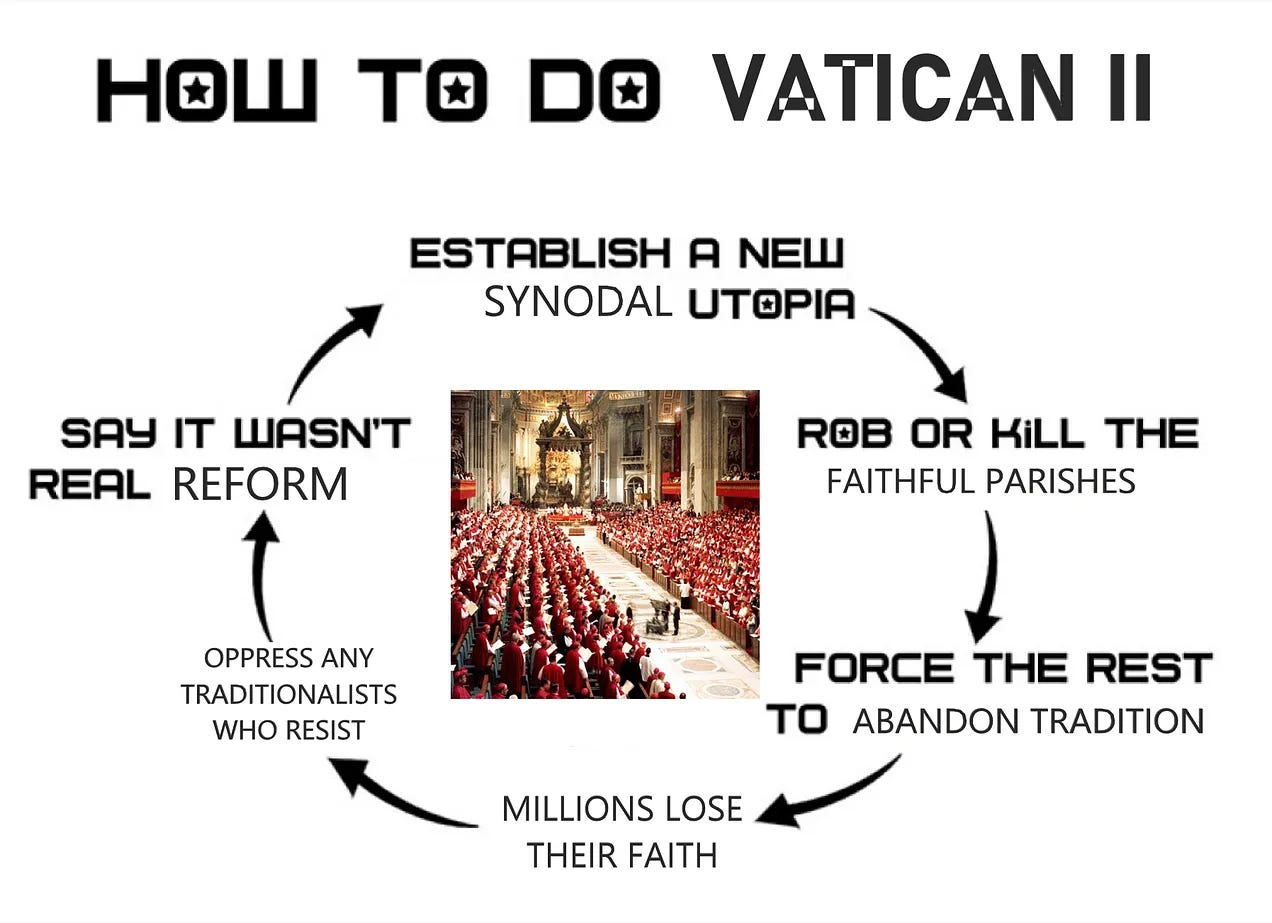
Cardinal Mario Grech knew you couldn’t wait, so he dropped you a little appetizer of a publication that “seeks to promote a broader understanding of this phase of the Synod’s implementation process.”
Let’s dive in.
Actually, since the summary is 11,359 words long all by itself, why don’t I just summarize the summary and give you the highlights?
Summary of the Summary
Here’s the exciting good news and glad tidings of the work so far on the latest synodal five-year plan that the interim report wants to share with us:
A diverse group of people met to perform a listening process session. Much discernment from the representatives of diverse perspectives shared specific practices, beliefs, and experiences that we assembled by means of synodal processes to form a synodal reflection about the ways that future documents could be crafted to best perform continuing synodal reflections that will open up new questions for synodal discernment.
The coordinators will continue to set up new subgroups and consult with the interim experts and report back to the secretariat until the implementation phase concludes for this session, before we return digital missionary perspectives to the forefront of the next phase of discernment and begin synodality’s enriching next phase of execution.
The results were valuable and confirm that synodality is the right path forward for the synodality to become more synodal and make everything more synodal.
Repent and believe in the Gospel synodality.
Got it? Amazing right? But if you had trouble understanding, I’ll go one step further for you, and translate the meaning of each section from the document from its original synodalish.
Translations
Here is what each of the sections of the interim report, detailing the work so far of each of the synodal commissions, means in plain English:
Some aspects of the relationship between the Eastern Catholic Churches and the Latin Church
Revising Eastern rite canon law to make it more synodal.
To Hear the Cry of the Poor and the Earth »
Nothing wrong with the first half of this on principle. But what is the cry of the Earth referring to but our need to send more money to the UN to fight climate change? Perhaps the crying of poor Melty the Icecap will stir our hearts to conversion?

There is an opportunity in this group if you’re from the Middle East. They’re hiring!

The Mission in the Digital Environment
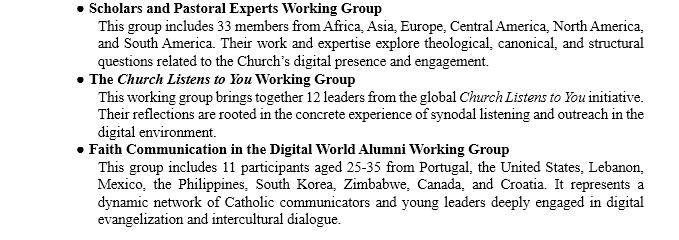
Ensuring that online content made by Catholics is synodal. They also launched a cool project called “The Church Listens to You” to discuss “shared experiences of digital accompaniment.”
The revision of the Ratio Fundamentalis Institutionis Sacerdotalis in a missionary synodal perspective,
To eliminate methods of priestly formation that don’t “connect well with today’s complex world.” In other words, I fear, to ensure that the world determines the methods of priestly formation more than the Church.
Some theological and canonical matters regarding specific ministerial forms
Trying to reopen the question of ordaining women to the diaconate by asking it again and again until they get the answer that the synodal coordinators want.
The revision, in a synodal missionary perspective, of the documents touching on the relationship between Bishops, Consecrated Life, and Ecclesial Associations.
This one was puzzling, perhaps trying to put all monasteries under the direct control of the USCCB in the United States and analogous organizations in other countries.
Some aspects of the person and ministry of the Bishop (in particular: criteria for selecting candidates to the episcopacy, the judicial function of the Bishops, the nature and structure of ad limina Apostolorum visits) from a missionary synodal perspective
To enable laity (but, of course, only the synodal, err, progressive ones) to choose bishops.
The Role of Papal Representatives in a Missionary Synodal Perspective:
How to make papal nuncios more synodal.
Theological criteria and synodal methodologies for shared discernment of controversial doctrinal, pastoral, and ethical issues
How to be more pastoral and less rigid regarding all moral issues, err, uhh, how to respond to “emerging issues”
The Reception of the Fruits of the Ecumenical Journey in Ecclesial Practices
How to make synodality more ecumenical and ecumenism more synodal, and how to add more of both to the Church. Also, they plan to allow non-Catholics to receive Holy Communion. You wouldn’t be against “Eucharistic hospitality,” would you? Or are you a bigoted traditionalist, are you…
The liturgy in a synodal perspective
The purpose here is to make the liturgy more synodal, which apparently means more decentralized, with more options. Also, ensuring that more of the readings from the Bible at Mass are about women and portray them more positively. Did you know that they request your input directly at synodus@synod.va (Yes, it’s real and not a joke.)

The Canonical Commission
This seems to be the Politburo of synodality, and its job is to listen to the other commissions and be synodal to them. Yet it also pastorally directs them toward greater awareness of diverse synodal perspectives..
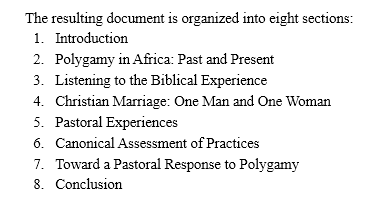
SECAM - On the Pastoral Challenges of Polygamy
This one might stand a chance of being orthodox, but let’s check the footnotes when they come out with the final draft to make sure:
Alright, What Is This About, Really?
Maybe the best key to understanding and translating synodality isn’t by trudging through the morass of documents.
Maybe we should just look at the words that are in the synodality and notice what’s missing (or almost entirely missing).
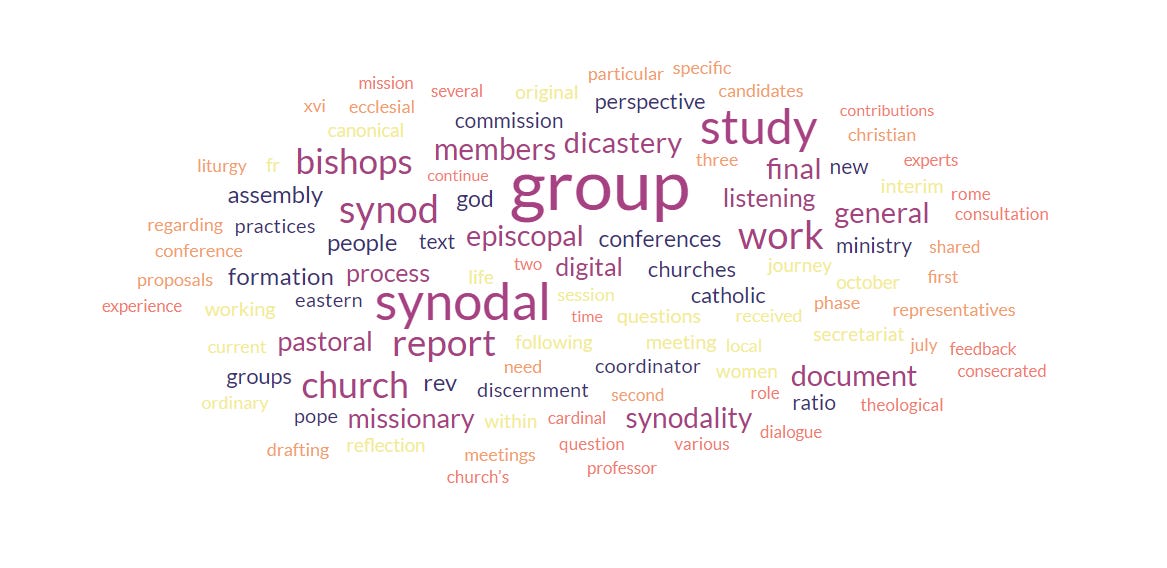
There are many words about processes, talking, managing, encountering, and sharing, but almost nothing about God, the Gospel, Jesus Christ, salvation, grace, and sin, and even very little about the liturgy, the sacraments, or the hierarchy.
The synodality interim report document could quite easily incorporate lyrics from parodist Weird Al Yankovitch’s songs:
We must all efficiently operationalize our strategies, invest in world-class technology, and leverage our core competencies; in order to holistically administrate exceptional synergy, we’ll set a brand trajectory using management philosophy advance our market share vis-à-vis our proven methodology with strong commitment to quality effectively enhancing corporate synergy, transitioning our company by awareness of functionality, promoting viability, providing our supply chain with diversity we will distill our identity, through client-centric solutions, and synergy.1
Synodality speaks the language of bureaucracy, of management, of secular psychology, and government to the point that it reads like a parody (or an overstretched final form of these systems).
But compared to Pius X’s Pascendi or Paul’s Letter to the Romans, it’s almost like it’s speaking a language from another planet:
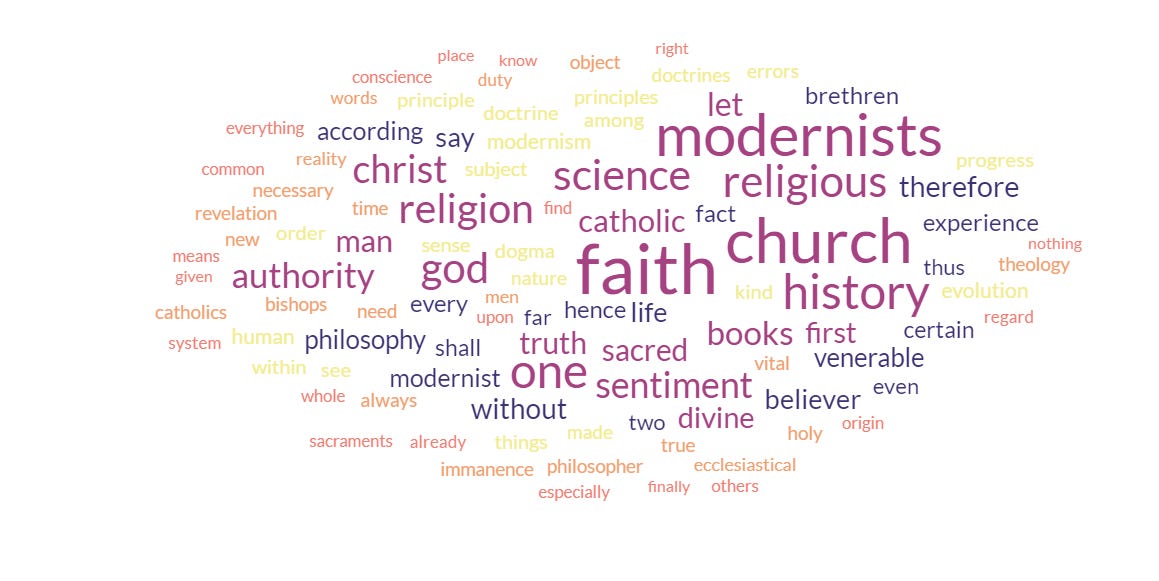
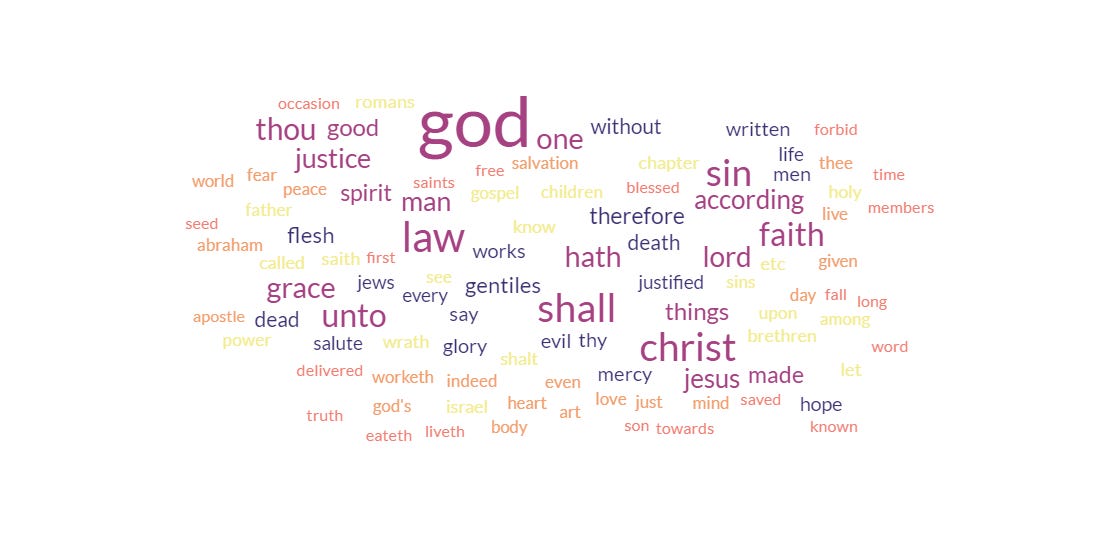
Even transcripts of Soviet Politburo meetings almost seem closer to what the Secretariat of Synodality is giving us than the latter do to just about any prior Catholic document:
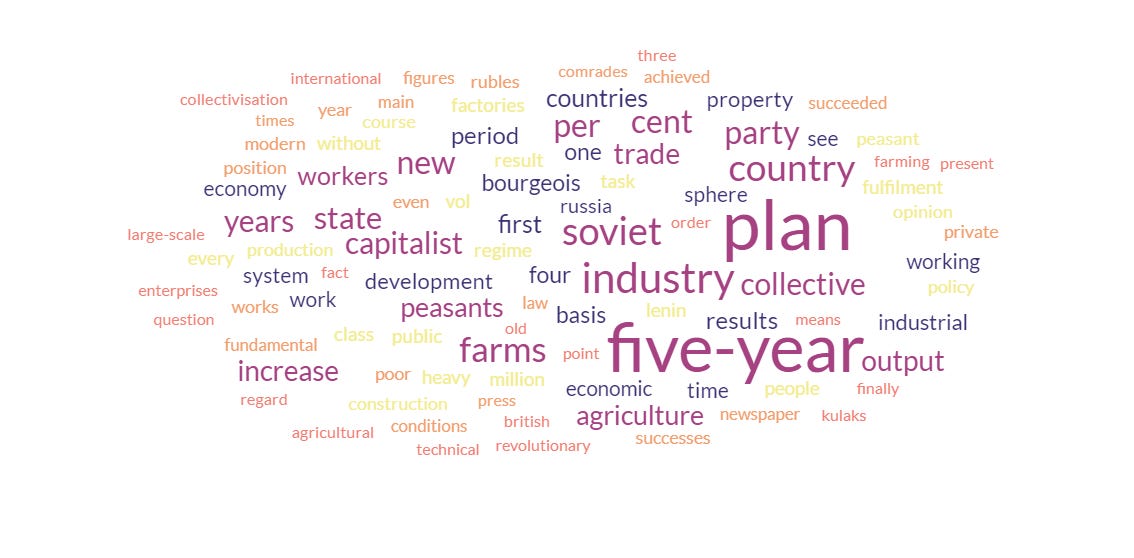
Like its compatriots in Marxism and the business version of Marxism, managerialism (see James Burnham), synodality’s unique-sounding dialect of gibberish-speak does have a point, manipulating language, and it does so in two ways:
Throwing gibberish at the wall to cover over simple truths with confusion
Using Russell conjugation, that is, to selectively utilize words that are rhetorically loaded in a way that shifts the discussion in a predetermined direction, like saying “women’s access to the diaconate.” You wouldn’t be against “access”, would you?
Maybe a primary key to what synodality is is the fact that a lot of it is just a bunch of bureaucratic nothingness gibberish intended to be confusing doctrines of the faith aren’t discarded, but just buried under so many tiring, err, “liberating” “synodal encounters” that everyone has gotten fatigued “freed in the spirit” from that we can’t even find them.
Gibberish, hence, reveals itself as the final form of managerialism whenever bureaucratic overlords, unable to come up with a successful, plausible marketing strategy to justify their rule, just throw random nonsense words at the crowd and hope that even if nothing sticks, at least they beat an escape or buy themselves time before the truth catches up with them.
Yes, the progressivist synodalists are also trying to use it to manipulate the faith, to pass evil off as good and good as “harsh” and “backward,” and “rigid.”
And, yes, unfortunately, they are succeeding in certain areas. It looks like synodality is planning to attempt to create even more of a mess with the doctrines of the faith, with fully normalizing and outing the Lavendar Mafia that forms the tip of the spear of the modernist infiltration of the Church, ordaining women, giving the Holy Eucharist to non-Catholics, and performing further science experiments on the liturgy, and Commissar Martin (amidst others) is here to enforce the edicts of syndality if you don’t accept them freely.
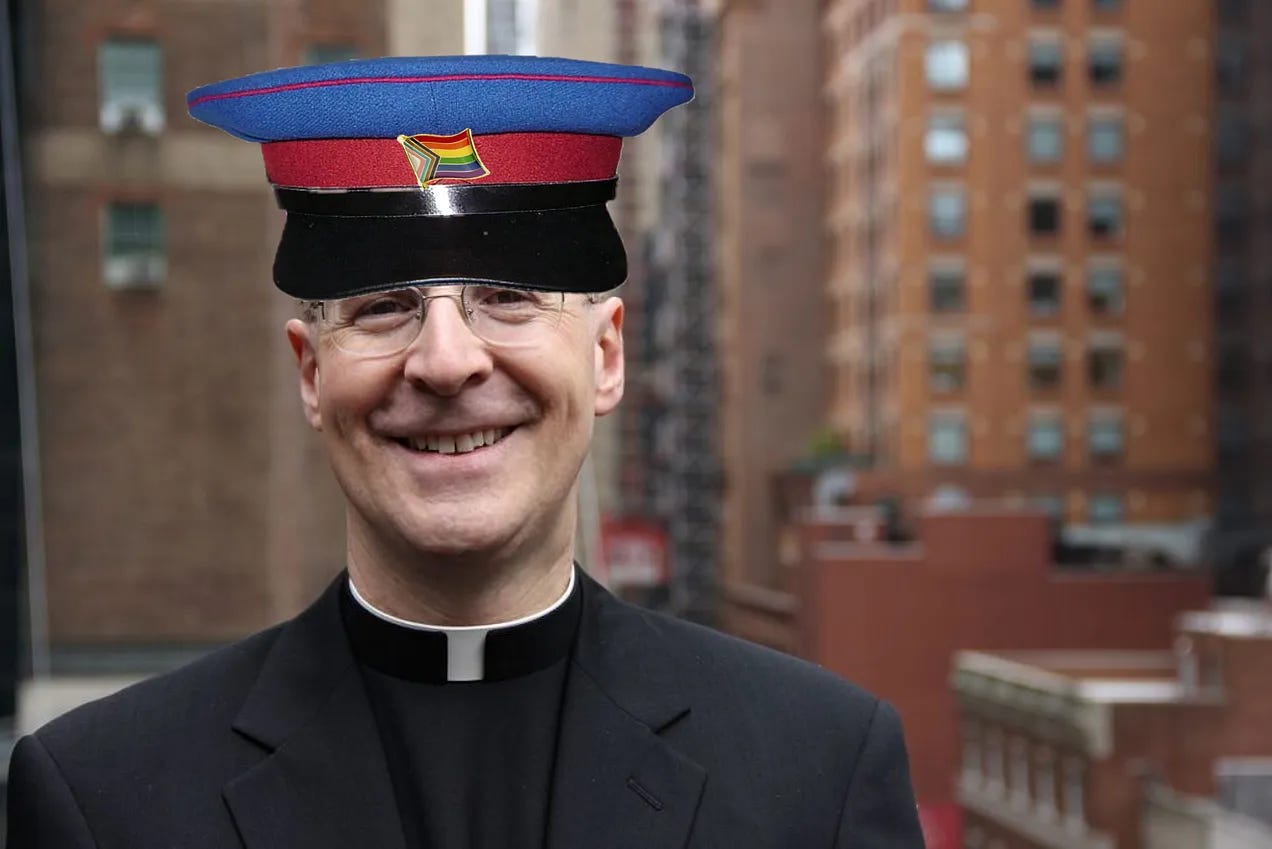
But remember, on the positive (maybe) side, that the fact that a movement supposedly centered on joyous renewal has to be rammed down people’s throats with ever increasingly extreme, very unsynodal coercion, might herald that we’re actually near the end of our encounter with the Synodal Era. The synodalists’ increasing boldness and demonstration of force reveal a fundamental weakness.


Unlike the Faith itself, which is sustained by God raising up Saints from the ground up to profess, defend, and witness to it, synodality can’t sustain itself because it’s not an organic movement.
Synodality may make kitchy videos, and they might make some funny posters, but they “can’t meme.”

But we can.
They don’t have the faithful on their side, and we not only but we also have the Saints on our side.
And when you’re fighting what appears more and more to look like a war, even when it’s against bishops who seem dead set on destroying the faith, those are the strongest of allies.

And they don’t speak synodalish. They speak the truth of the Word.


Weird Al Yankovitch’s parody “Mission Statement”

Something tells me the scriptural Jesus might not have been on board with what we are currently enduring.
I understand perfectly now. You make it make sense. Big dose of sarc taken while reading recommended not only by doctors.