

Quantifying the Catholic Revolution
1965 Was the Tipping Point: A U.S. Catholic Statistics Project (1900-2025)

To put some harder numbers on the effects of Vatican II and the broader Catholic Revolution of the last 60 years, I’ve been doing some calculations with the CARA (Center for Applied Research in the Apostolate) data on Catholicism over the last few weeks.
While the Georgetown University-affiliated research center certainly publishes a lot of interesting data that’s been circulated at length in Catholic circles recently to make arguments about the effects of Vatican II, its numbers only go back to 1965, right in the middle of the Council. Furthermore, there’s a broader gap in Catholic-related data and charts everywhere for the 1960s and before. Few consistent sources give data for both before and after the Council, a gap that makes determining the overall effect of the Council difficult.
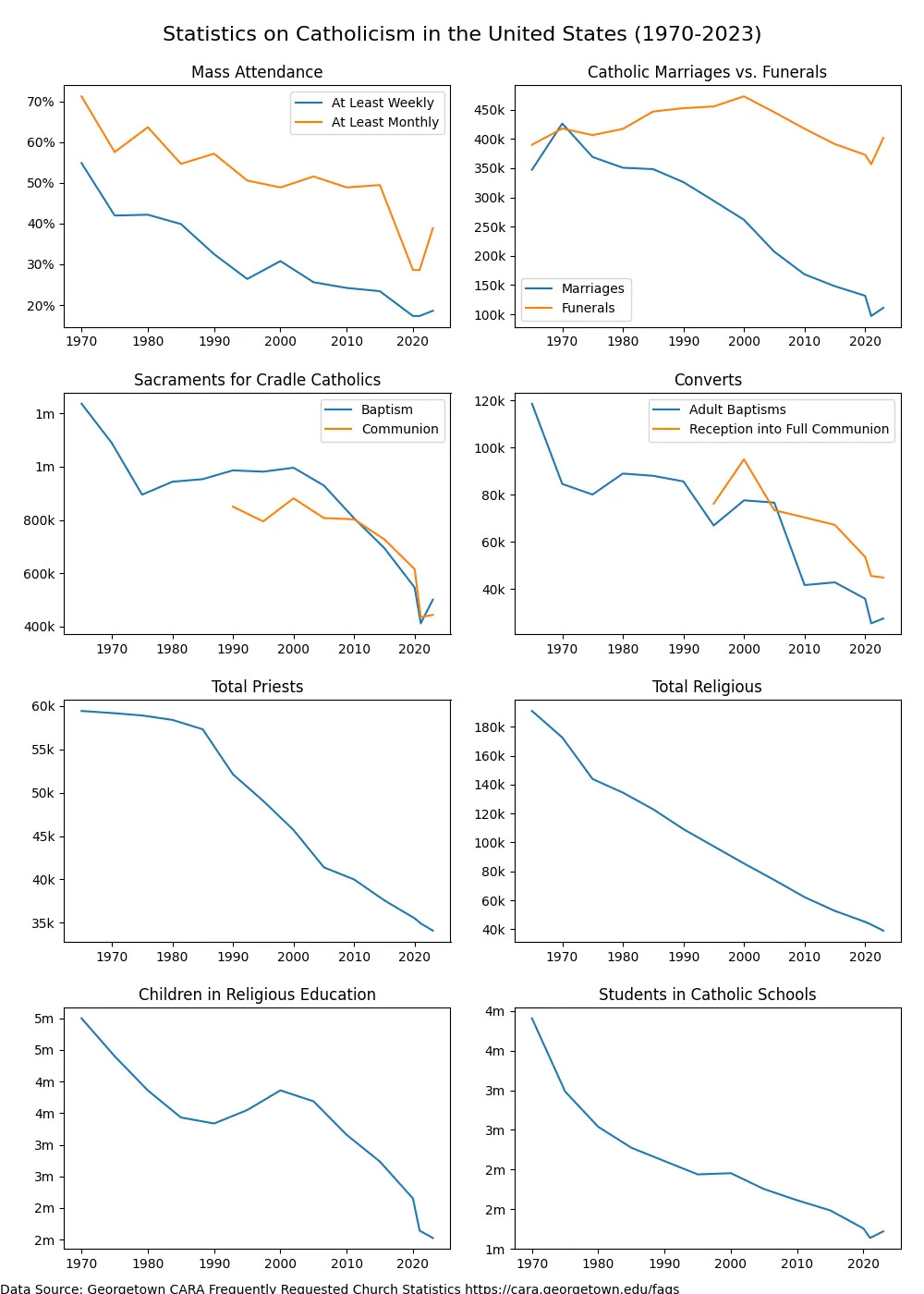
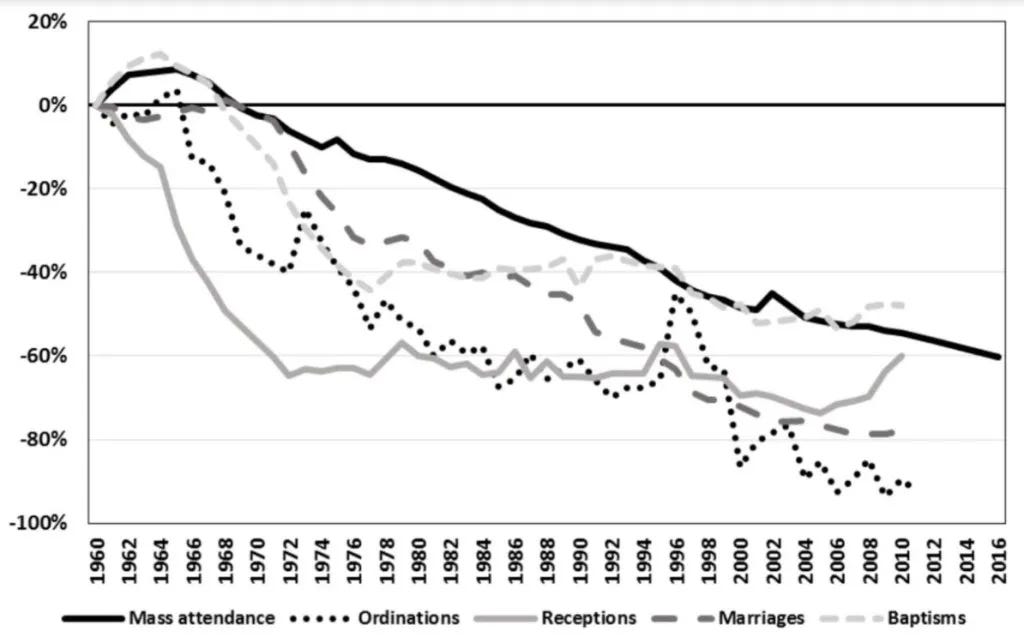
Was the Church ascendant in the United States before Vatican II? Or had decline already set in? Did the Council help compared to what would have happened had pre-conciliar trend lines continued? Or did it cause (and/or accelerate) decline? Without a consistent data source for both before and after the Council, these are hard questions, besides using anecdotes or one’s own preconceptions to answer.
Looking at the data from 1970 onwards, it’s clear that a crash occurred, one that I’ve argued occurred from the revolution hurting (filtering out) the faith of many of the most faithful Catholics first, before later causing more general declines in Catholic practice, larger and larger numbers of officially registered (but more nominal) Catholics notwithstanding.


Proving this larger story definitely, and not by mere anecdotes, however, requires data from before and after the Council, which again is rather hard to piece together. The data collection and processing so common to managerial control and planning today, the habit of trying to put a number on everything, wasn’t really a priority for the Church at the time. (I’m not sure what, but that probably means something…)
I have found a few indirect ways to piece data together to complete the CARA dataset, for at least the United States, to try to more definitely prove that Vatican II (or at the very least the revolutions enabled in the name or spirit of Vatican II) were the cause of declines in Catholic faithfulness and practice. TLM_Ryan has been doing some good work in this space as well over on Pre-Conciliar Radio, but I’ve been interested in putting together my own data to use in my own future articles.
This requires cobbling together various reports from news articles, Catholic publications, and secular data sources over the last 125 years, as well as some estimations, as there are different methodologies for determining who is a Catholic, especially with a large rise in nominal Catholics and a decline in Mass attendance over the last 60 years. Still, I’ve pieced together several interesting graphs and charts on Catholicism from 1900 to the present that are available in the data set below.
There’s a lot more to do in this space in terms of actually analyzing the data, and I’m planning to use these calculations in some upcoming articles, but for now, here are some briefs on some of the most interesting observations I’ve made so far from graphing various trends against each other over time.
Dataset

Catholic Statistics (Web Version) (Expanded Version of CARA Dataset)
Catholic Statistics (Google Sheets Version) (Expanded Version of CARA Dataset)
To be continually updated at the above links. Some of it is still a little rough, and there are a few gaps I’d like to fill in with more detail, but there’s quite a lot in here that I’ve built on top of and to extend the CARA data set.
Catholic Population vs. Priests and Religious
While the U.S. Catholic population (both by offically parish registered Catholics (yellow line) and by surveys (blue line)) grew quickly in the early 20th century and has generally grown ever since, the number of priests and religious sisters has declined since 1965, even though it grew more quickly than the general Catholic population before that time.
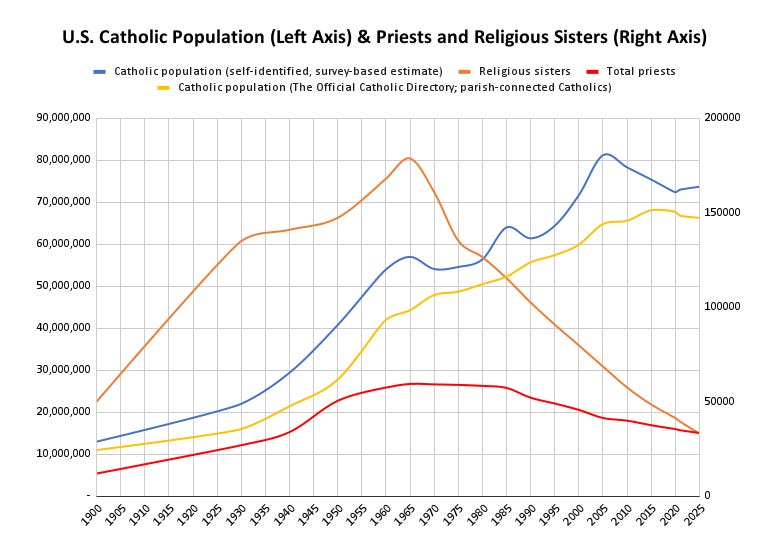
There are negative signs on the horizon, as this metric of self-identifying Catholics, as weak a marker as it is, has been declining in absolute numbers since around 2015.
Mass Attendance
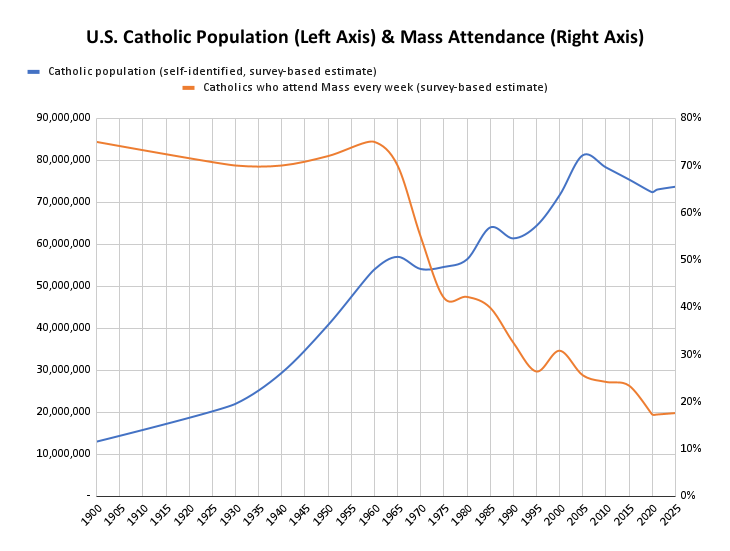
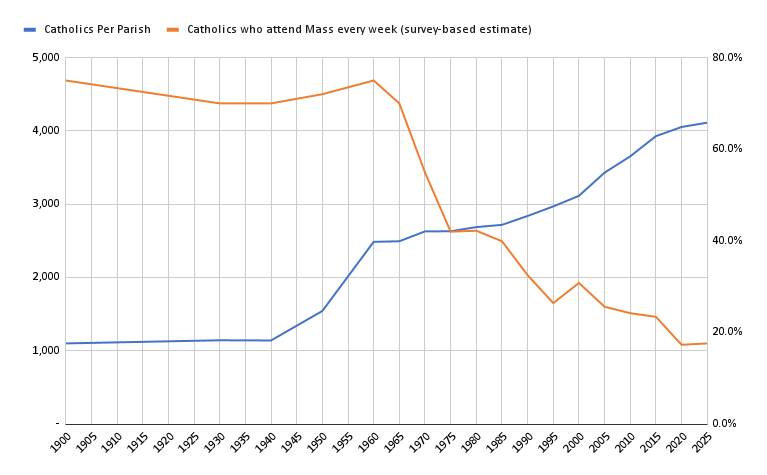
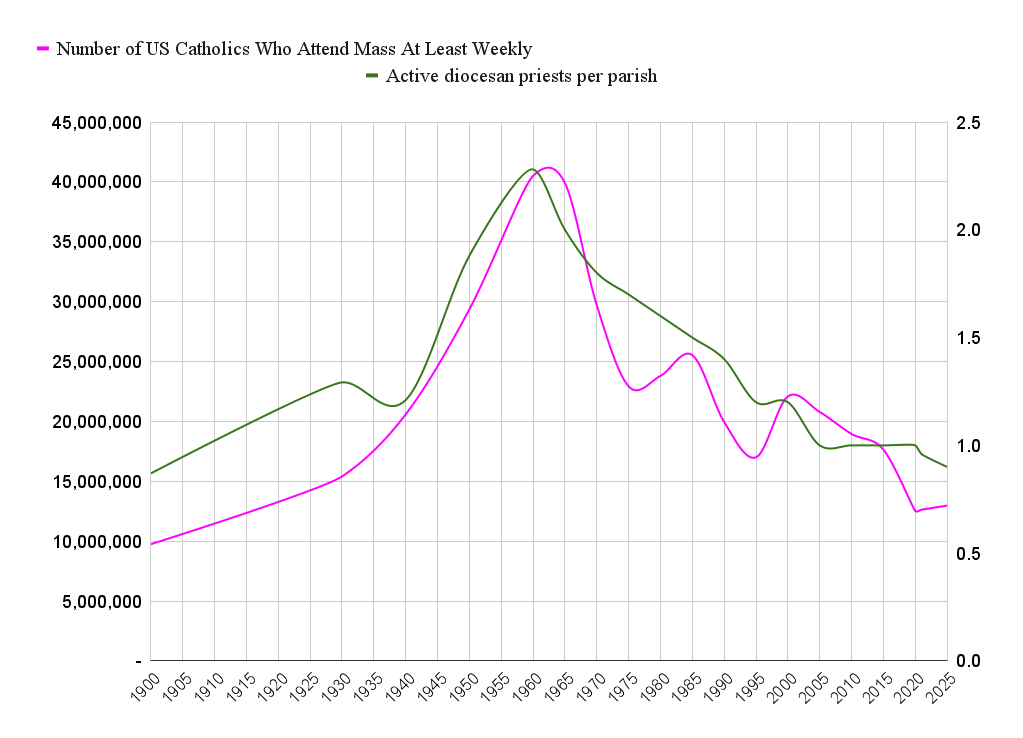
Ever since 1960, the growth in the Catholic population since 1960 has not kept pace with weekly Mass attendance, meaning that, at present, a vast majority of U.S. Catholics don’t attend Mass every week.
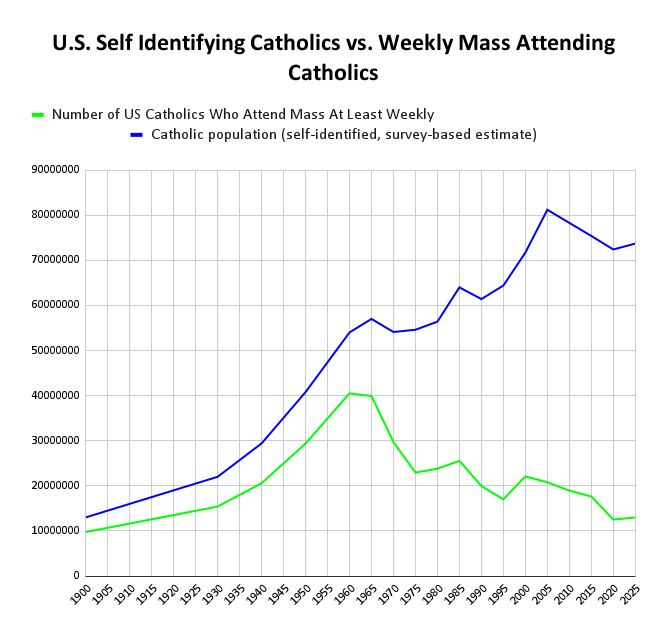
Weekly Mass attendance has never recovered from its 1960 peak, even though the official Catholic population has grown by 40%. Rather, it’s crashed in absolute terms by 67% and in relative terms from around 75% of Catholics meeting this most basic requirement to only around 17% attending Mass weekly as of 2025.
The red line I added to this chart below of Catholics who don’t attend Mass every week is particularly shocking in the rapidity of its post 1960 and especially post 1965 growth.
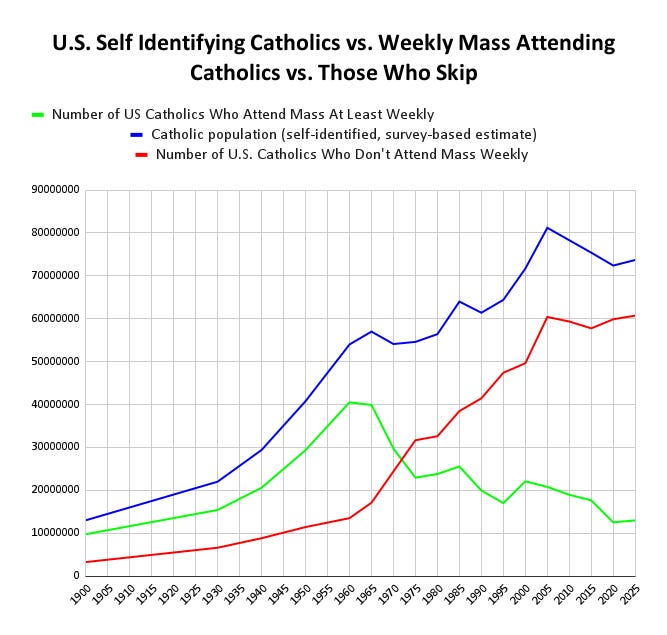
Mass attendance rates in the United States, after holding steady to slightly increasing after World War II, declined sharply beginning in 1960 and have not recovered, although Pope John Paul II’s election seemed to halt the decline for a decade before it started again. There was another brief bump around 1995, but the overall trend remains downward, with only 17% of self-identified Catholics attending Mass every week as of 2025.
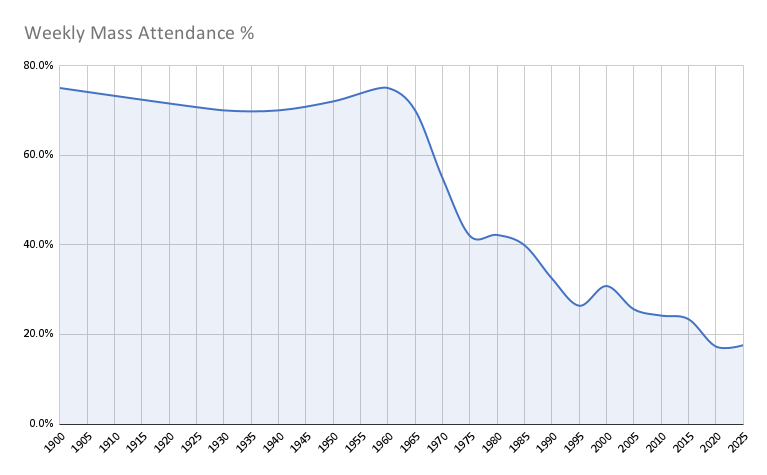
If any one graph encapsulates the crisis, this is it. Once, in mimetic terms, the model of calling oneself a Catholic but not going to Mass weekly becomes normalized, a whole lot more comes into question, and the decline becomes, given that so many other Catholics are slacking, a lot harder, given mimesis, to reverse in the case for any one individual.
Priest to Catholic Ratio
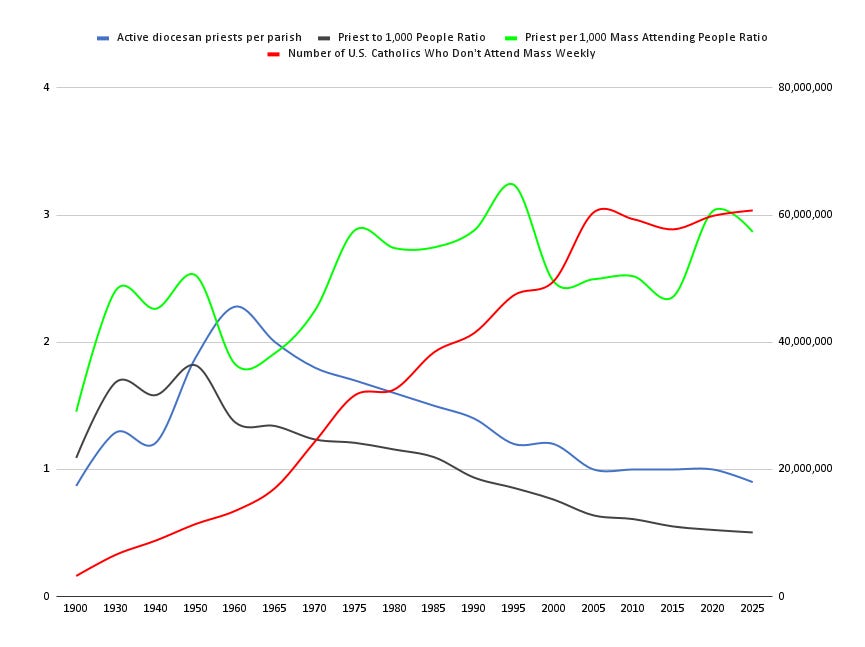
Since Mass attendance rates have drastically fallen since the 1960s (red line), and there’s also been a large decline in the number of priests, meaning that the average priest is stretched more and more thinly (blue line).
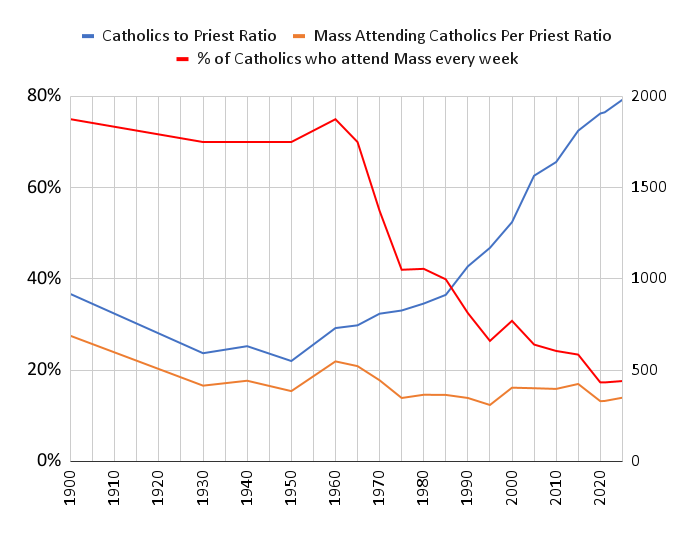
However, the number of actual weekly Mass-attending Catholics each serves has remained relatively constant (gold/orange line), suggesting, as I’ve proposed, that there’s a hard limit both on how many actually practicing Catholics a priest can effectively minister to. Perhaps this is related to Dunbar’s Number, the idea that there’s a limit to how many social relationships any one priest can manage at one time?
The fact that this ratio, about 300-400 weekly Mass-attending Catholics per priest for most of the last century, the only time period that America has been more than a mission territory, is so close to the higher end of Dunbar’s Number estimates, at least feels like more than a coincidence to me.
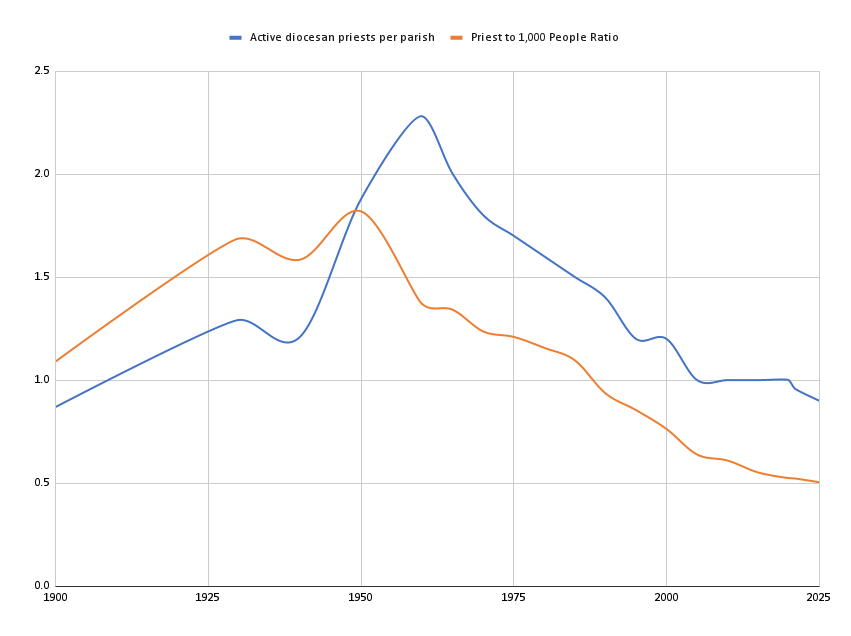
This point is bolstered by the slow but steady decline in priests per parish, even as parishes have grown fewer in number but larger over the last 60 years, with fewer priests ministering to larger and larger parishes of more and more nominal Catholics.
The thriving local neighborhood parish, in other words, has on average been replaced with the more distant, larger, and lay-dominated parish that the average Catholic attends far less. Such seems to be a key contributing factor to the mass psychosis of the Catholic revolution that I’ve been arguing about. The average practicing Catholic of the early 20th century, both literally and metaphorically, lost his organic parish and the traditional liturgy, his physical and liturgical spiritual homes, and then had them replaced with a lay-led, distraction and nominal-Catholic-filled, and priest-short alternative.
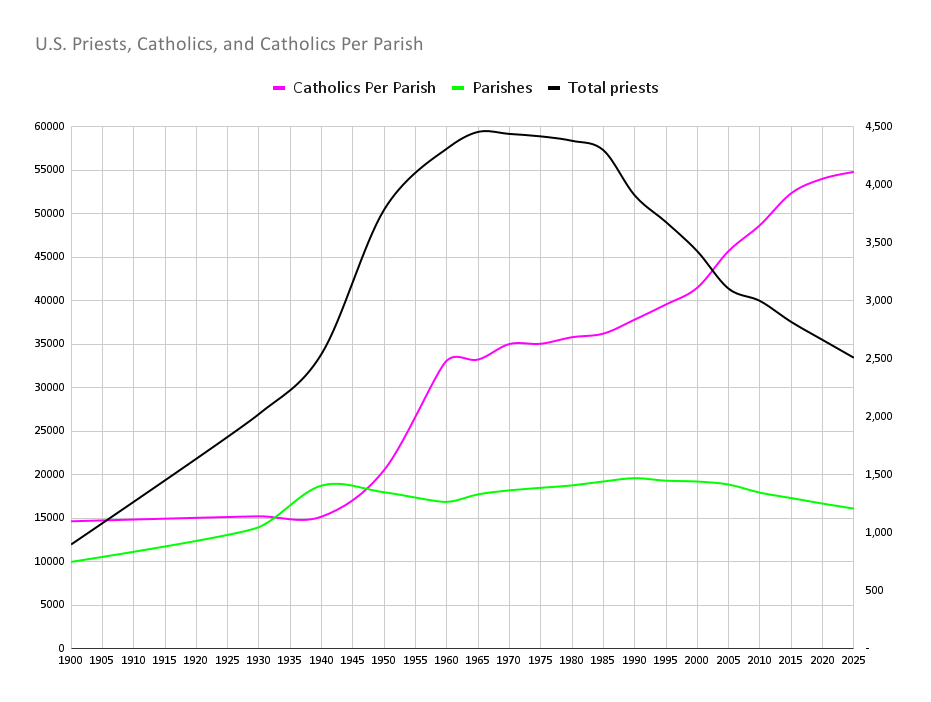
Catholic parish size (including the ever greater number of nominal, registered, but not Mass-attending Catholics In Name Only) grew before Vatican II, flatlined with the Council until immigration numbers began to increase their size in the late 1980s, even as the total number of priests, flatlining with the Council, declined sharply starting in the 1980s.
Meanwhile, some of this increase in parish size was driven by parish closures, which began, interestingly in the 1940s, with many local neighborhood parishes beginning to be replaced by larger, more distant ones, a trend that continued for the next few decades, although suburbanization led to a brief uptick in the 60s, before the number of parishes began declining and has recently, begun declining faster.
These larger parishes, relying less on priests and more on “lay ministers” and managerialist practices to run their operations, may be able to retain official numbers of on-the-books Catholics, as nothing can truly make up for a lack of priests in the statistics that matter, as the chart in the next section shows.
Religious Sisters
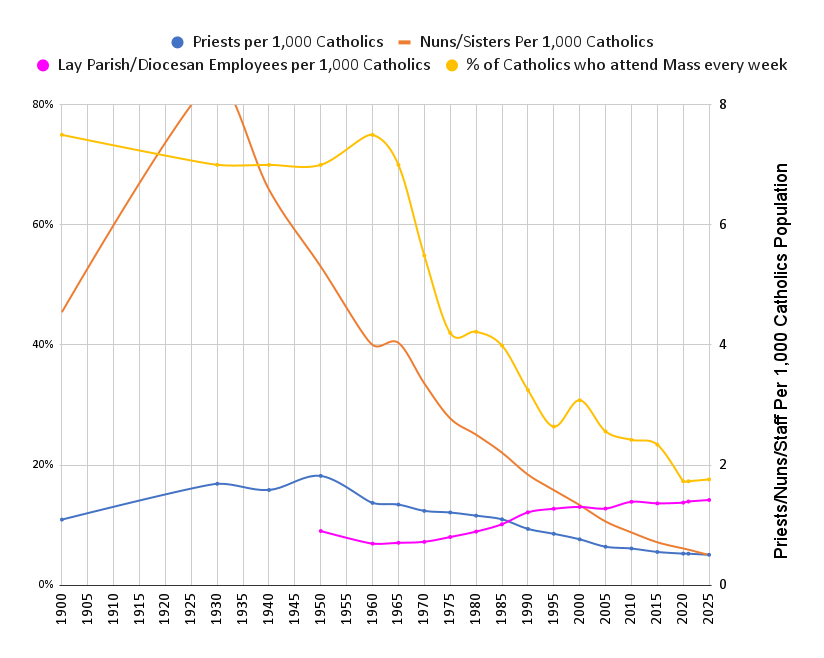
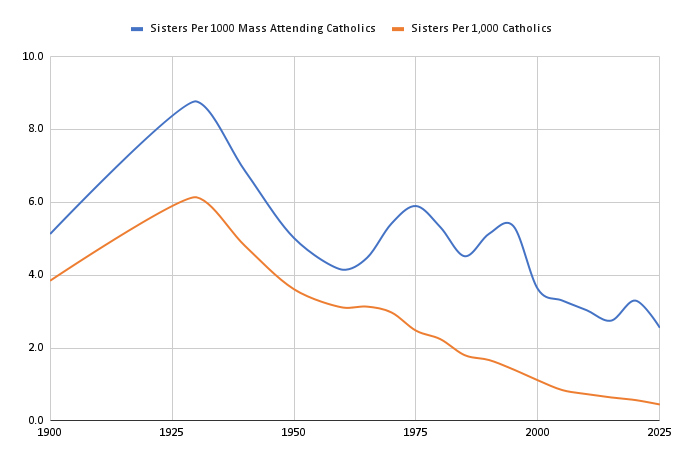
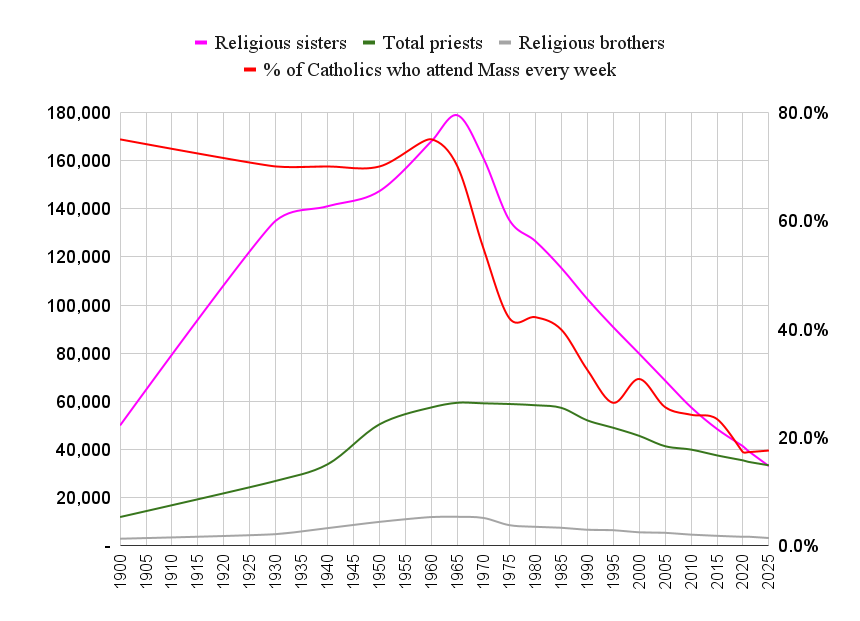
While the decline in the percentage of Catholics who attend Mass every week (in the US) is stunning, it also tracks on to an even larger drop in priests/nuns per capita, one where even as priests/nuns were increasing in absolute number until Vatican II, and immediately crashed in number thereafter, they had been falling on a per capita basis since around 1930 for nuns and 1950 for priests, suggesting that something had happened before the Council that its changes created the perfect storm to exacerbate as far as religious vocations are concerned.
Perhaps many of these early vocations were foreign missionaries to the United States,1 and the U.S. never produced enough vocations on its own until the 1960s, before the Revolution cut it off and crashed religious life entirely?
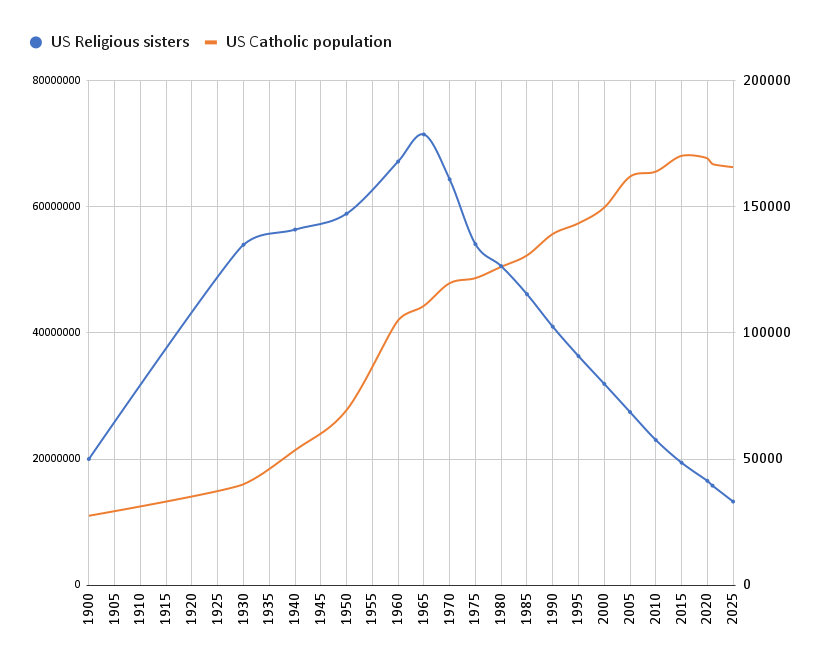
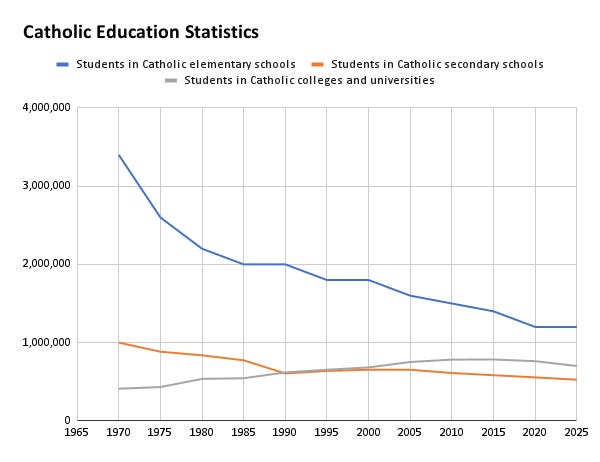
Religious vocations in absolute numbers, however, were still on a strong upward trajectory until 1960, fuelling the average Catholic parish and school system (though stretched a little thin by the 1960s) with the resources needed to maintain a Catholic school system that largely collapsed in the 1970s and beyond when there weren’t enough religious to effectively keep the schools, and other Catholic initiatives running without resorting to less effective lay staff.
If you graph the total number of priests and religious sisters and priesats parish against Catholics who attend Mass every week, there are strong correlations, suggesting, perhaps only suggesting, that not only are the declines correlated in their cause, but they also feed off of each other, with shortages of priests and religious contributing to declines in parish life, especially again as the numbers of priests and religous per 1,000 weekly Mass attending Catholics has not declined anywhere near as sharply as the rate per 1,000 total Catholics.
The number of priests per weekly Mass attending Catholic has actually increased slightly since 1950.
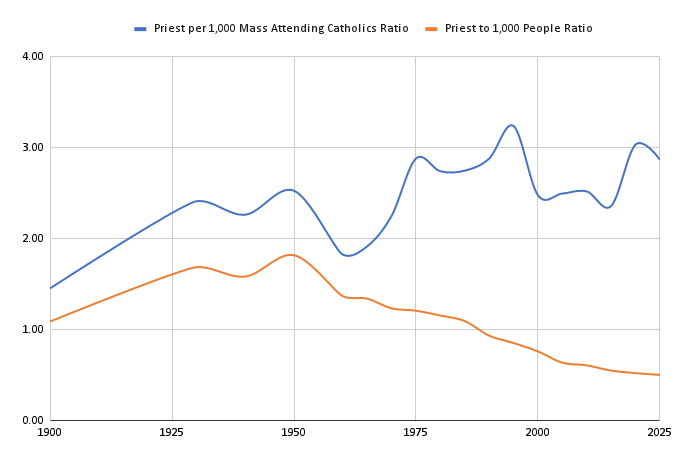
Still, priests are being stretched more thinly across a more and more nominally Catholic population, meaning they have to spend more of their time with parish programs encouraging nominal Catholics to be at least minimally engaged.
Projections
This isn’t overly scientific, or anywhere near as detailed as some of TLM_Ryan’s recent analyses of current Catholic demographics, but here is an attempt to model a few of these trends over the next 15 years.
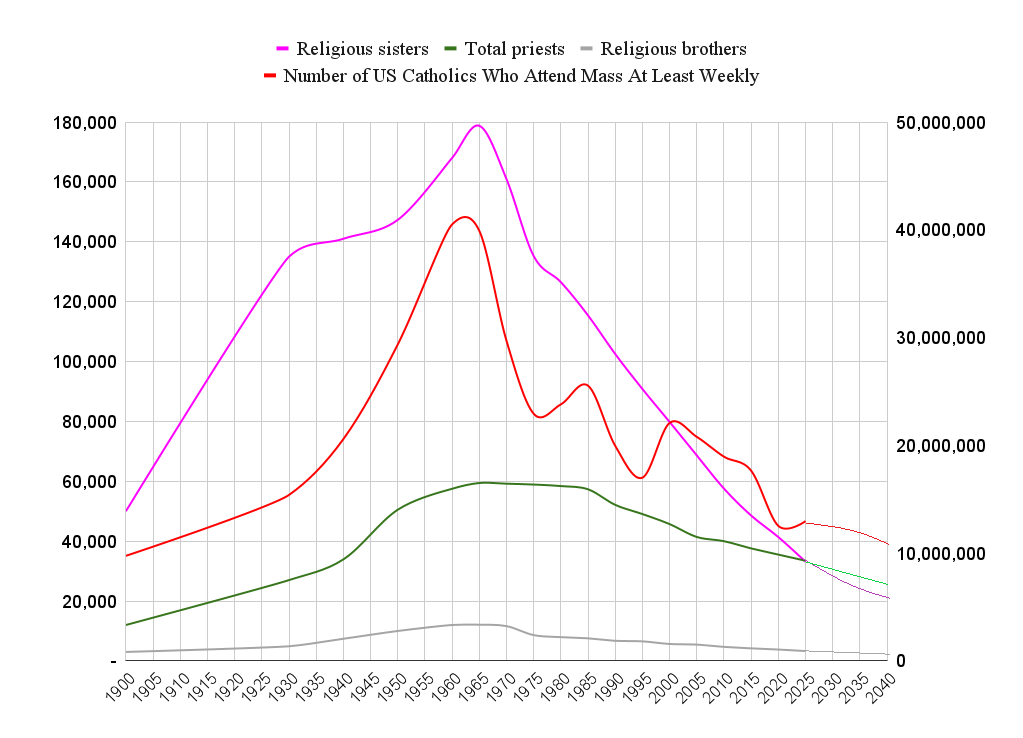
It’s not pretty.
Conclusions
I’ve only done a cursory job of thinking through this data so far, with a lot more to come as I hope to use it in my upcoming articles, but the general conclusion (admittedly, I thought this beforehand) is that Vatican II was a primary accelerator of the decline in Catholic practice in the United States.

The data, generally, seems to support this.
Again and again, although more granular data would certainly help to bolster this, the five-year period from 1960 to 1965 seems to be the tipping point for nearly all the negative trends in Catholicism in the United States.
However, other factors, such as demographic changes, larger, more bureaucratized parishes, and a slight decline in religious vocations per capita before the Council, seem to indicate that the Church’s resources, though strong, were stretched thin before Vatican II and that the Catholic Revolution didn’t entirely come out of nowhere. The fact that the number of parishes in the United States declined in the 1940s and that per capita religious sisters were growing more slowly than the general population from 1930 onwards are surely something I’d like to look into more.
Neither, it seems, was decline inevitable, Council or no Council. Rather, the declines brought forth by the revolutions in Catholic liturgical practice after the Council, as well as the loosenings of doctrinal orthodoxy, came about by an exploitation of the Church’s weak points. Declines in certain areas, such as in the number of priests and religious per capita, served as contributing factors to the negative effects of the revolution, making a bad situation, at least in the United States, far worse, with effects compounding on each other to produce ever further and presently continuing decline.

More to come…
Please let me know if there are any particular numbers you’d like me to attempt to calculate or source, and if you have any particular questions as to methodology.
A (happy?) blessed Lent to all.
The 1924 Immigration Act, as much as it may have helped build a more demographically cohesive United States, probably contributed here to cutting off foreign missionaries to the United States.
Interesting stuff here. I have seen this kind of thing outside the church. I once worked for a police organisation - at one time it had a lot of rules in a large book which defined everything in the job. It created a culture, where everyone had a clear understanding of expected standards and ethics. This was determined to be too rigid in the modern world (sound familiar?) and so the big book was abolished, with much less definitive guidelines introduced instead and more left to the individual. Result: poor knowledge of the law, leading to poor decisions, loss of culture, decline of law and order and loss of respect for police in a kind of doom loop. I've seen this pattern replicated many times in different areas. While people still remember the old ways, things carry on, but the new people do not get the same training and so do not follow the old rules. This is what seems to have happened after the Council; memory lasted for a while but all the old certainty about the faith was stripped away, and so people lost the patterns of behaviour and belief. Eventually there just seems to be no point to the religion at all. It's sad but there is only one way to fix this; bring those old principles back.
Whatever we did that precipitated the collapse must be undone ASAP!