

Diocesan Inc.
The Second Avignon Captivity of the Church

The question of why a revolution succeeds or survives, why, even when it’s clearly failing, it manages to stay in place, and uninterested parties don’t overturn it, is far more interesting and practically relevant to reversing it than merely trying to get the motives of the villains right. In the revolutions in Catholic faith and practice over the last 60 years, asking why so many Catholics are indifferent to failing policies and declining metrics is far more important than merely pointing out that people are trying to subvert the Church.
Certainly, the Lavendar Mafia in the hierarchy of moral corruption running to the top that Gene Thomas Gomulka, Dr. Kwasniewski, Janet Smith, and many others have pointed to is the most obvious factor behind the revolutionary mindset still possessed by many a hierarch, with many of them seemingly actively opposed to the faith over which they are the leaders.

But while this corruption runs deep, it’s not the whole story. In the liturgical revolution of the 60s, most of the priests and bishops weren’t ideologues or morally corrupt but were swept along by the propaganda and manipulation of those who were, and who were more focused on manipulation. Similarly, in the broader “Catholic Revolution” of the 60s, most people weren’t ideologues, but were carried along with it, because the Church’s enemies, instead of a direct assault, tried a charm offensive. Rather than fighting the Church outright, the Church’s enemies were now offering to help, pretending to meet the Church’s naively open approach with their own warm (yet false) welcome. They “helped”, or “infiltrated”, that is, by building up a power structure that is not the Church but exists within and around it, and to which the bishops—and many others—abdicated authority, a system of managerialism which turns the bishops into mere puppets or guardians of a system of secularization that is smothering the faith from within.
Why do the priorities of the bishops we hear so often sound so much like blatheringly secular corporatist or governmental speak? Why does it seem so hard to get them to speak clearly on any matter of faith and morals that’s not aligned with the interests of the world? Because, at a high level, the Church’s institutional power has been abdicated ever since Vatican II to the world of corporate managerial and government concerns, and the bishops are just the middle managers for a process that they feel is outside of their control, a treadmill that they feel they can’t leave.
It’s not the French this time, but we’re in a sort of second Avignon Captivity of the Church.
This is the story (probably just the beginning) of “Diocesan Inc.” or the managerial infiltration of the Church.
The Managerial Utopia

The infection and revolution that hit the Church at Vatican II was multi-faceted, but can be framed as the same managerial revolution (c.f. James Burnham and Sam Francis) that transformed the traditional governments and businesses of the past into the corporate behemoths and the interlocking administrative empire that exists today. At its core, managerialism is the twin idolatry of technocracy and scale. It is the worship of the ideology that all problems have scientific solutions, that humans can be managed to perfection to be perfectly happy and fulfilled, and that technical “experts”, producing micromanaging strategy plans with ever-increasing economies of scale, is the way to achieve this utopia.
Besides being laughingly and falsely idealistic in their political practice compared to their outcomes over the last century, technocracy or managerialism is an inherently materialist ideology, aiming at building a heaven in the here and now by turning even more power over to claimed experts. Managerialism isn’t merely having managers or a bureaucracy with people assigned to particular tasks, as these are necessary in all systems past a certain size. But managerialism is worshipping these systems, believing, or at least publicly avowing, that they, on their own, can perfectly fulfill man’s deepest longings while people with the organization and ability to manipulate, administrate, and organize gain systemic power over all their rivals by doing exactly that.
Once in vogue, managerialism always claims that putting more and more of human affairs under the control of master plans and efficient mass organizations, that is, under the control of managerialism, will achieve better results. Though technocratic utopianism for the fulfillment of human desire is how managerialism sells itself to the masses, the secret sauce of managerialism is that it treats humanity itself as just another object of technocratic manipulation.
Humanity becomes a Heideggerian “standing reserve” of “human resources” or “elite human capital” for the managers to manipulate, the state becomes a telocratic instrument that produces social and economic transformations in the people, and every problem in society is just another justification for giving more power to the managers to produce “master plans” to fix it.
Managerialism Hits the Church
The managerial ideology infected everything in the 20th century, the Church being no exception.
Now, of course, the Church has always had a structure and has always interfaced with secular powers, Canon law, rules, procedures, and systems of organization and administration. However, for most of its history, even when the Church had strong political power and was at the peak of its influence in the Middle Ages, it never had a large bureaucracy, and especially not a lay one.
What functions and management had to be done were left to the ordained hierarchy to arrange as they saw fit in a model of subsidiarity, with as many decisions left to the lowest level possible, leaving lots of latitude for tremendous, saintly men to do whatever was needed for the salvation of souls. The utopia is in heaven, of course, not here below. The only, in the end, that matters, is the salvation of souls, not efficiency, a beautiful org chart, or managerial best practices.
Over much of the 19th and early 20th century, the Church also had a particularly adversarial relationship with secular governments around the world, standing strong as a sign of contradiction against the utopian humanistic liberalism of the French Revolution and associated atheistic thought that promised an earthly utopia. Standing as a bulwark of truth and orientation towards eternity against the relativism and modernism of the day, the Church valued her independence, the bishops their role as guardians of the doctrine of the Faith and of the Sacraments, with eternity, not this world, being, as it should be, the central orienting principle.
This all changed at Vatican II, with the attack vector into the Church being the naive belief, as was the spirit of things after World War II, and especially true in the drug-fueled, heady psychoses of the 60s, that cooperation with worldly powers would do the Church more good than being a sign of contradiction.

The managerial power structure infiltrated the Church right after this through the vast new bureaucracies created surrounding the liturgical reform and the staff needed for “full implementation” of the council, always, as it is, just around the corner, as well as to replace the work done by the declining and shuttering religious orders after the New Springtime turned to Fall.

As the Church hired more and more lay experts, managerial organizations: bureaucratic conferences of bishops, parish councils, Non-Governmental-Organizations (NGOs), and business cartels (look into GIA publications) took on an outside role in setting the program, goals, priorities, and bounds for the Church. Power transferred away from the Bishops as individual heads of the Church in their region and towards the vastly growing lay bureaucracies, as well as to the national bishops’ conferences that Vatican II advocated for.
Bishops, priests, and even Popes, even if they had other ideas, get sidelined when Susan from the Parish Council threatens to report on you through some new “official” structure. Bishops can’t run their dioceses alone and aren’t truly sovereign in their role and duty of responsibility to shepherd those under their care. Rather, the USCCB, for example, sets the guidelines, or lets an outside group or government do so. If this week they’ve decided that you’re all closing churches due to COVID, well, you ain’t allowed to think twice. Neither St. Dominic nor St. Francis would have fit well in a modern bureaucracy or gotten along well with the institutionalized practices of the average diocese today, and neither would have most Catholics throughout history.
The Church has been infiltrated under managerialism to eliminate the threat that it’s transcendent narurally provides against managerial utopianism and to prop up the broader managerial system by using the infiltrated Church to prioritizing, as is ideologically evident in Vatican II’s Gaudium et Spes, a far greater emphasis on “universal brotherhood” rather than eternal life, what a great new writer named Alyosha calls a “globalist software” or a “‘lowest common denominator’ form of spirituality, one that promotes social cohesion without causing the trouble of claiming exclusive salvation.”
The Church has, he adds,
... settled into a symbiotic relationship with secular global institutions. It effectively operates as the spiritual voice of globalism. Its prelates speak fluently in the technocratic dialect of the world elite. They prioritize climate change, migration pacts, and sustainable development over the uncomfortable realities of sin, judgment, and redemption.”1
The Church is co-opted, its mission is not abandoned, but just so papered over with distractions from its core mission that there’s little time—or bandwidth—left over for its leaders to devote to saving souls.
Branch Officers for Diocesan Inc.
Under the managerial ideology, what is the bishop but a local branch officer for Diocesan Inc. or Catholicism Inc., a well-respected member of the “family of religions” who works to provide a humanist softer touch, comfort, and relaxing hope to the rougher edges of human life under managerial rule. And, in certain ways, the bishop himself is more of a figurehead than a real leader as Piers the Plowman (Darrick Taylor) argued in Crisis Magazine, with the bishop himself not even really running the show:
Like every other institution in western life, the Church is run on a daily basis by those who control the means—of communication, funding, and the like—to accomplish the ends for which they are constituted, rather than those who are responsible for its end. In the Church’s case, this means the salvation of souls often takes a back seat to bureaucratic inertia.2
In the managerial systems of today, power trickles down the managerial networks to the titular leadership through the “networking” and “transition” programs that ensure the new hire is properly aligned with the system. Just as ideological conformity is ensured for members of the managerial class by the institutions that train them for managerial roles, the bishop is also trained for his role by members of the managerial class.
Training—Or Propagandizing—the Bishops
Take a look, for instance, at the “Episcopal Transition Service” proffered by an organization called the “Catholic Leadership Institute” that reminds me quite a lot of the organizations that propagandized and managed the rollout of the liturgical changes of the 60s in the United States.


Bishop Mark Beckman, for one, recently appointed to the Diocese of Knoxville, and one of the top generals of the Counter-TLM alliance of the Bishops’ War, praises the Episcopal Transition Service for “preparing him to hit the ground running.”

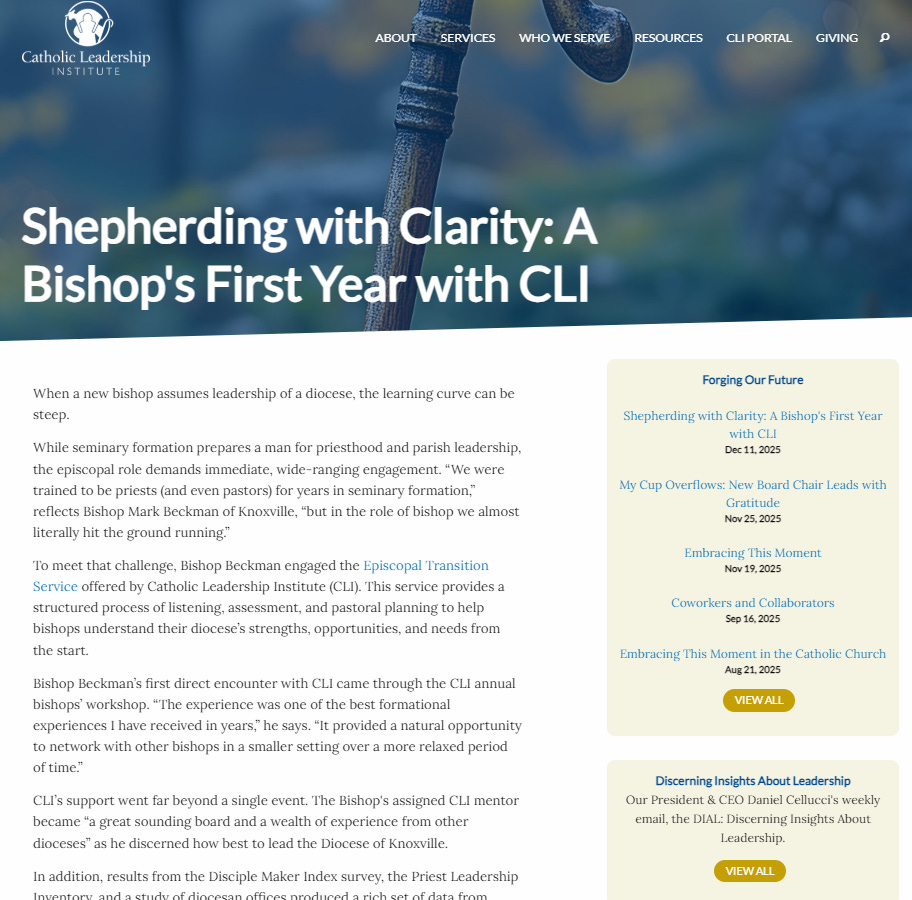
I’m not here to say that being a bishop isn’t difficult. Bishops today are the custodians of a vast bureaucracy of resources, agency, and government relationships, obligations, and responsibilities to manage.
With expenses in the tens or hundreds of millions and assets up into the billions, but with staffs, across all associated organizations, in the thousands, large payouts needed to cover abuse settlements in particular, and lots of pressure and scrutiny, maybe the Episcopal Transition Service and the “ongoing skill coaching services” they offer are necessary to equip the bishop to keep the “offices, ministries, personnel, resources, and key processes” of his diocese running smoothly.
The problem is that bishops today are too busy, constantly distracted from their real role, being the guardian of the Faith, the Sacraments, and especially of the unity of the Church in their Diocese. And training bishops to be administrators reinforces the idea that there needs to be large bureaucracies and relationships with the secular world to administrate, distracting them further from their proper role in the Church.

Under managerialism, with large organizations run on every level by specialist managers, the real power flows from those at the center of information flows and the ability to advise, propagandize, or manipulate those with titular authority, aligning them with the interests and agenda of the managerial system—and with that of ideologues within that system.
Who’s really in charge, the man with the job, or the one who trains the new man to do the job? The bishop, or the group that trains him in how to be a bishop?
In more than a manner of speaking, the Catholic Leadership Institute, among many other organizations like it, by telling the bishops what to do, is wielding the real influence and control, alongside the lay bureaucrats, the “Deep Church”, over and above the bishops themselves.
The Department of the Church
Even worse, the sprawling nature of the Church’s holdings intertwines so much with the government’s that the Church as an institution is in many ways more a department of the government than independent, beholden to maintaining its relationships with secular power.
The financial dependence of dioceses, the United States Conference of Catholic Bishops, Catholic Relief Services (and during COVID, with billions of dollars dispersed to parishes in Paycheck Protection Program funding) on government funding ties the Church to the system, as with Catholic Relief Services’ being 80% dependent on the government to the tune of $1.1 billion a year, and the USCCB itself getting 60% of its revenue or $180 million a year from the government.
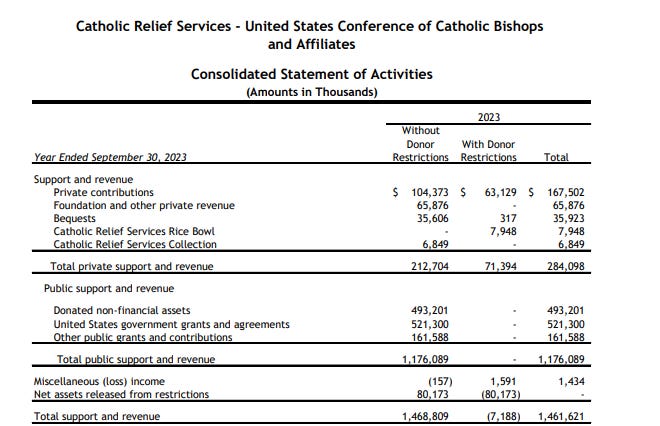
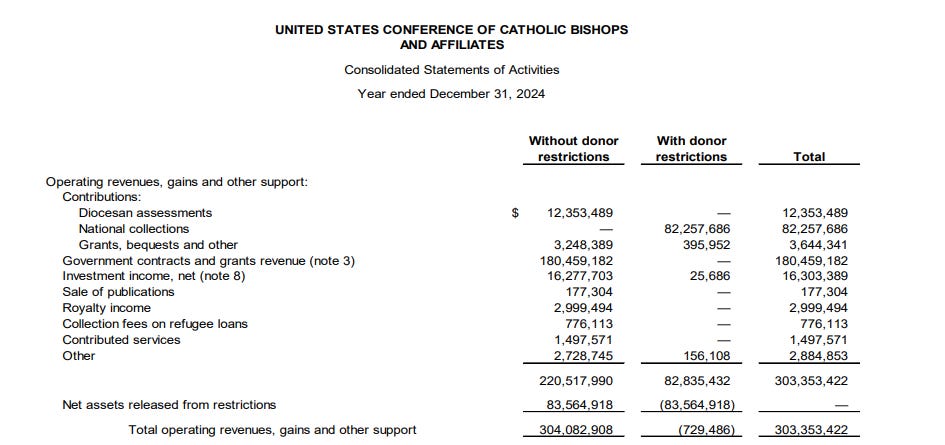
While the DOGE shuttering of USAID last year, from which much of this money flowed, will surely cut these numbers, the financial dependence of these organizations in the United States on the U.S. government in matters of immigration, health care, education and related services remains, and as Vicki Yamasaki argues, begs the question, “Who Really Controls the Catholic Church in America: The Bishops or The Government?3
The threat of losing the Church’s tax-exempt status if it were to engage in anything that the powers that be consider threatening, like taking too strong a stance on moral issues, further smothers the independence of the Church. If a bishop were to fight this system, to attempt to refocus the Church in his diocese on the true primary mission of the Church, they’d threaten the relationship with the government, the very alliance [parasitical relationship] that gives them their power.
For many a bishop, to do so would be to question their own legitimacy for being a bishop. Few are willing to do so. The ones who do, in a self-defense mechanism by the rest of the managerial system, often get cancelled.

The reason Bishop Strickland was sacked while Fr. James Martin, for all his flaunting of the faith, remains powerful and in the public eye is that the real client of the institutional bureaucracy of the Church is the government and not the faithful.
If you depend on the government, you work for the government. And that happens to have consequences.
Strickland threatened the Church’s relationship with worldly powers, while Martin (and many others) make outreach and bridge-building to the government, at the price of making the faith merely an emotional appurtenance. As a Dominican named Fr. Totleben (in an extremely softball critique of Fr. Martin, put it:
People are so exercised about Martins problematic advocacy for LGBT issues specifically, that they have mostly failed to notice that this is only one part of the larger problem with his ministry: his ministry is to be the chaplain for the Beautiful People. Martin is the kind of priest who reliably will show up at high society events like the Met Gala, a socialite who will cultivate relationships with all the Right Sort of people.
And Martin sees his ministry in general of basically re-assuring the Beautiful People that Jesus agrees with them, that their values don’t even need to be baptized, because they are already fine. Martin’s project is to ransack Christianity to find ideas that he can revise so that he can give some sort of spirituality to the value system and worldview of the Beautiful People. Because, after all, since they are the Elite and the Beautiful People, their values are good and set the pace for the rest of society.
Martin isn’t exactly opposed to people going to Mass. It’s just that that kind of Christian discipleship is superfluous for the Beautiful People. And, of course if you are an elegant Manhattanite, the LGBT cause is one of your darlings. So, of course, that cause is going to be one of Martin’s darlings, and he’s going to do for it what he does for anything else. He’s going to tell you how Jesus already agrees with you, because as an elite Beautiful Person, you must be a good person too, and he’s going to try to craft a spirituality that fits your values.4
This secularized emotive spirituality is the type of utopian happy-go-lucky-positive feelings-and-we-don’t-talk-about-sin attitude, oriented toward this world, which pervaded the liturgical reform project and which now suffuses synodality. Ironically, since it makes no demands on people, few want it, it being a mere knock-off version of secular liberalism, but Martin, many bishops, and Co. continue selling it, because it’s their ticket to the relationships with the secular government that keep the Church’s institutions funded and in power.
Paradoxically, in looking to preserve their power, the bishops abdicated it to those, the managers and propagandists, government or otherwise, who are running the show, whether it be through the banalization of liturgy through the Liturgical Industrial Complex of GIA Publications and OCP Press profiled by the Lepanto Institute, the the government grants pushing leftist agendas on every parish, LGBT mobs pushing their agenda, or the “We just need to Vatican II harder” agendas.
And as the managerial institutions Church declines across a wide range of metrics, rather than addressing the real root of the problem, the turn of so many in the Church of the Church’s resources towards secular agendas, managerialism provides a managerial solution, the so-called full on Diocesan or Parish Transformation Programs, which propose that, guess what, better management strategies and more planning can “fix” the Church.
Diocesan Transformation Plans
“Pastoral plans” like reorganizing parishes into “clusters” are promulgated by diocesan management consultancies to dioceses as the silver bullet to reverse declines, while programs like Rebuilt Parish promise to help pastors manage their parishes through hiring their experts to perform comprehensive planning, reorganization, and metric tracking.
It all begins, according to their business offering, with a site visit to your parish on which Rebuilt will perform extensive analysis and then write a comprehensive report on what metrics need to be watched more carefully, what needs to be modified to align with industry best practices, and how a compelling “weekend experience” can be crafted.
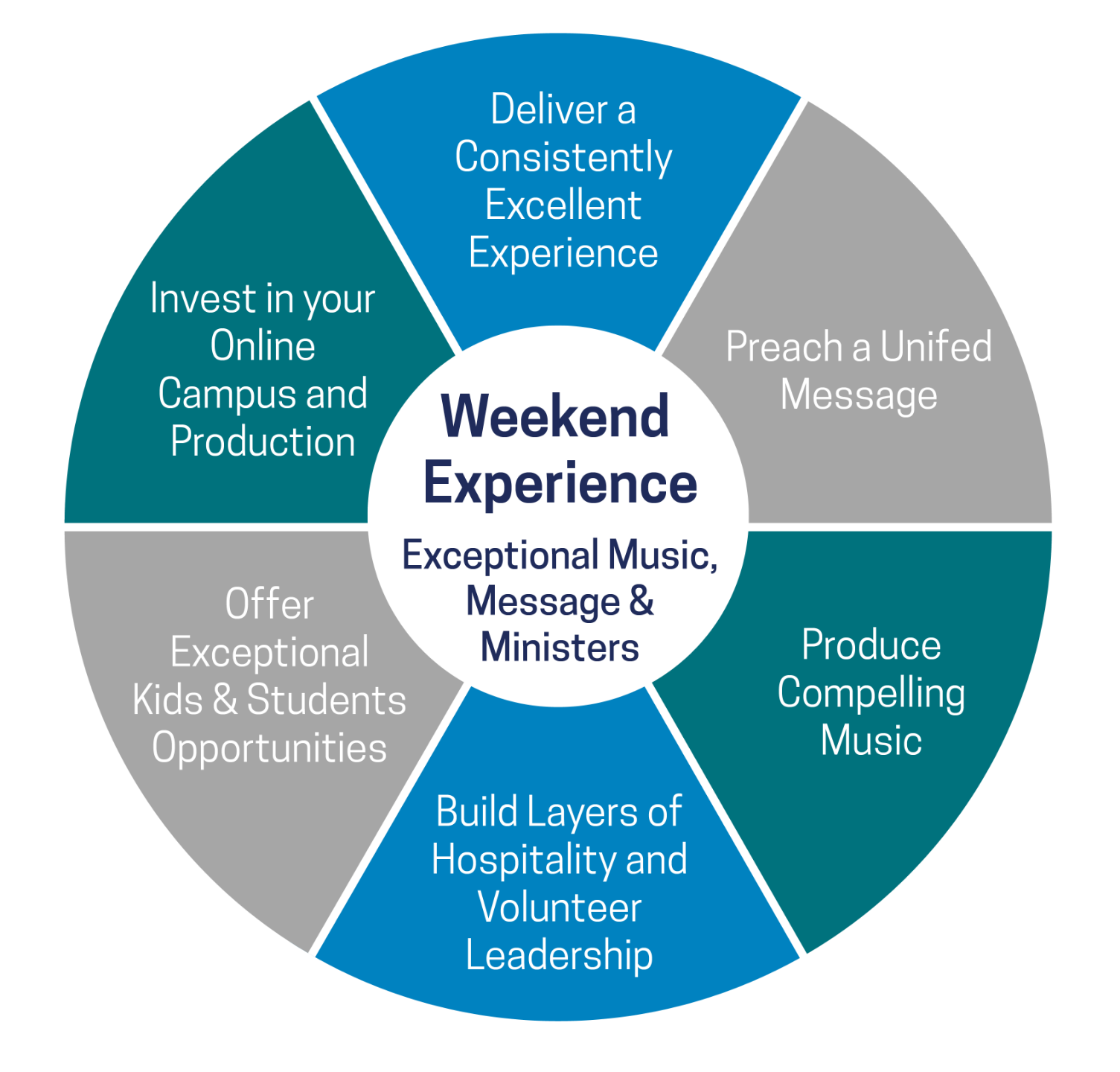
I assume this organization, at least on some level, means well, but what is conspicuous is how the Church is treated as just another human organization that needs to develop better management, marketing, and communication skills in order to succeed.
Notably close to absent are references to doctrine, the Eucharist, the Sacraments, grace, and God, even as the sites are filled with phrases like accompaniment, master-plan, data-driven, turnaround plan, and the like.
In other words, as ParishCatalyst, one of Rebuilt’s competitors, makes obvious, this is Synodality-as-a-Service, the synodal process of meetings, listening, plans, study groups, and reports in order to achieve, well, actually that’s the question.
What is this trying to achieve? It’s not trying to address the roots of why the Church in the United States is struggling, but merely, as managerialism excels at, to pass off responsibility by at least appearing like something flashy and productive is being done to address the crisis.
The Catholic Leadership Institute mentioned above is also in the business of “research-based” and “data-driven” master plan building for parishes and dioceses, advertising themselves as the masterminds behind diocesan renewal programs that entail, well, gathering data, developing metrics and targets, and then closing parishes, no mention made of the 30% or more who leave the faith entirely when their parishes close.
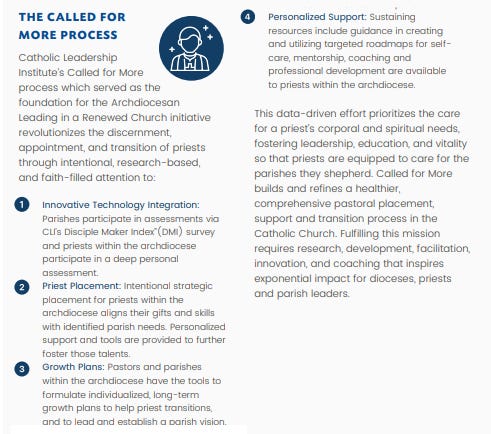
The CLI has implemented its Called for More and Next Generation Parish processes across dozens of dioceses over the last few years and touts their successes even as the decline in Mass attendance, vocations and contributions to the Church continues, parishes continue to close and eight Catholics leave for every convert and on the ground participants report that the outcomes are micromanaging, predetermined, and counterproductive to the actual practice of the faith in their diocese.

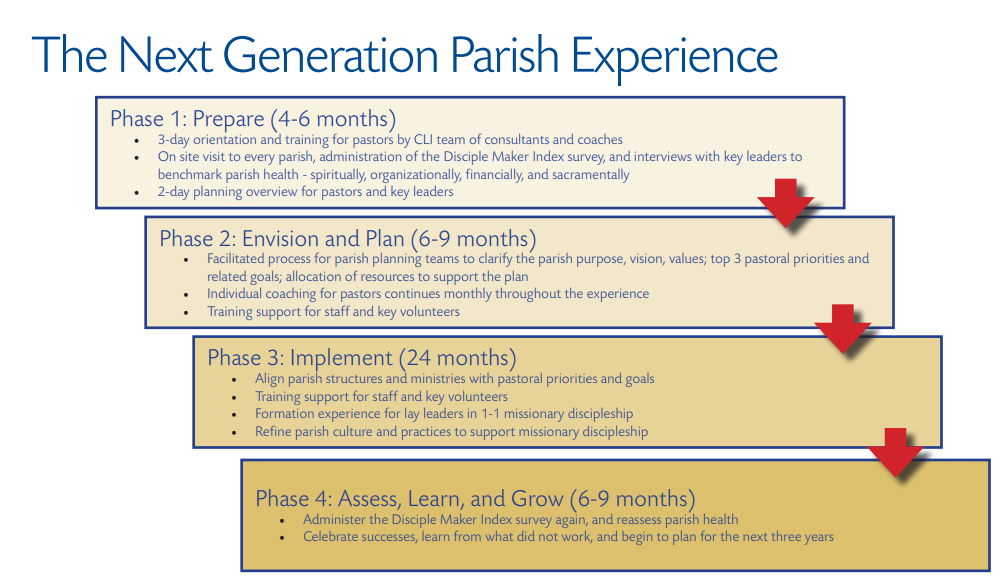
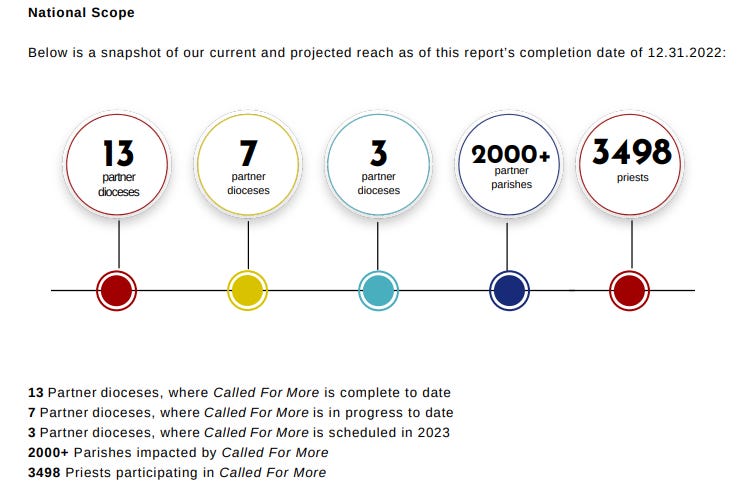
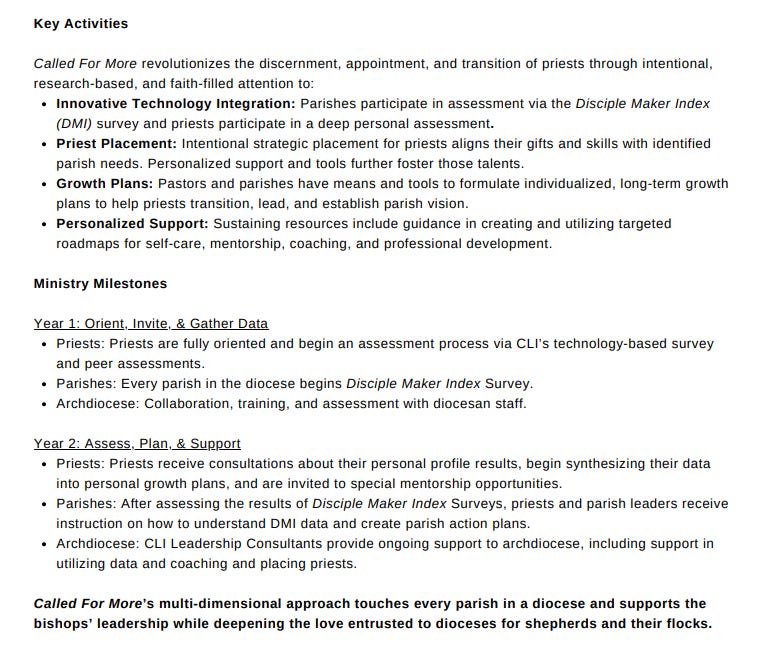
The CLI process is the same playbook as the ongoing “synodal” process and is endorsed by all the same people who enjoy synodality. Judged by their own words and results, neither is really about the Faith, God, or eternity. Both sell the same utopian illusion that management and not God will give man earthly fulfillment, with little focus on eternity or absolute moral truth.

These programs seek merely to complete the transformation of the Church into an NGO, liturgy into entertainment, and the clergy and bishops into mere functionaries for a system whose only real goal is to give a soft touch, some happy-go-lucky music, and emotional support around life’s rougher edges under managerial rule. The Church has been turned by managerialism from salvation into an emotional product or service to be marketed, sold, and managed.

The Second Avignon Captivity
The managerial infiltration of the Church is deep, both ideologically and institutionally. Churchmen have been in the habit of running the Church like a managed business for so long that leaving the technocratic secular paradigm seems impossible.
It’s not just that someone’s captured the Pope or that he’s defected from the truth. It’s not just the bishops or clergy who have apostatized. Some certainly have. But it’s not that the institution of the Church, which we must remember is not merely a human one, but a divine one, has been corrupted, but that a new, false structure, a control system that is not the Church, has grown up within the existing, true Body of Christ.

Like weeds growing up amidst the wheat or an infestation within the body, a network of infiltrating institutions that are not the Church has been choking the Church from within and corrupting the outlook and priorities of so many of its members, including many in the real hierarchy. They are at once real heads and princes of the Church and also project leads and senior vice presidents of the infiltrating structures that have grown up within it.
It is as some have put it, as if there is a schism within the heart of many who are in the Church, half orienting towards the world, and half towards Christ,5 or as Alyosha puts it, that we are in a sort of second Avignon captivity, the Church’s administrative apparatuses this time not captured by the French king as it was in the 14th century but by the American empire and the globalist secular technocratic elite.
If the declining metrics discussed by TLM_Ryan are any indication, however, people don’t want what managerialism is selling. Though the Managerial Captivity of the Church, the infiltration of its structures by secular practices, ideologies, and ends has claimed many souls and continues to hemorrhage believers, the faith, though so often smothered by the distractions and abdication of responsibility of the hierarchy, is alive wherever people take it seriously as Ryan’s own research shows, with metrics for the traditional communities, institutes, and parishes showing equal mass attendance, faith retention, and vocation rates to that of the Church before the managerial and secular modes organization entered after the council.
Though the historical lesson of the Avignon era captivity of the Church by the Capetian dynasty carries a warning: it ended with a schism that further rent the Church, what’s clear is that the Church survived then not due to kowtowing to worldly powers or embracing them, not by micromanagement nor technocracy, but by those, uncredentialled, but raised up by God in every age who continue to live the traditional practices of the Faith, living their lives oriented towards eternity, beings sign of contradiction and of grace toward the nations.
The Church will always be affected by the currents of each age, but must—and does—eventually stand above them, just as it is oriented towards eternity and not merely towards this world. Managerialism is a fad, hopefully a passing one. Though it is a revolutionary movement, it can’t really innovate; it can only parasitize off of what came before it. By prioritizing process and planning, it, in the end, fails to work, even as it selects for and rewards people who keep it in place. Like entropy or like a mushroom or blob, it’s not even necessarily a conspiracy; yet decadence and incentives perpetuate it as a system by ever-increasing propaganda or force, and not by being compelling on its own merits.
Diocesan Inc. is already clearly showing signs of failure. Soon, one way or another, the managerial structures will collapse by their own contradictions or by the collapse of the imperial bureaucracies that hold it up, and the Faith will be released from its captivity.
And after managerialism, the “New Pentecost” in the Church, in the real Church, the body of Christ and not the structures that have parasitized themselves within it, will come, but not by man’s manipulations, bureaucratic creations, or experiments. It won’t come from man turning inward upon himself to build a Church system that serves his emotions or gives him some sort of earthly fulfillment. It will come only from him humbly turning back to receive what God and his forefathers have handed on to him, and seeking that God, not Himself, may be glorified.

And it will come.
Alyosha, Between Two Ages, “The Engineered Revolution: How the American Establishment Installed Globalist Software in the Catholic Church” https://alyosha4.substack.com/p/the-engineered-revolution-how-the
Darrick Taylor, “Hierarchy as Middle Management”, Crisis Magazine. https://crisismagazine.com/opinion/hierarchy-as-middle-management
Men's Media Network shared some interesting details to me on how the government funding of the church in the United States (and therefore the control) accelerated under President Bush. Again, the pattern is interesting. Bush’s executive orders touted themselves as “expanding opportunities for faith-based groups” to receive government funding and not as regulating the Church, in other words, offering to help, but the end result is more government influence. He who pays decides.
It was the Bush White House in 2001 that pulled the coup harnessing churches for social control via Executive Orders. It wasn’t some left wing social movement. It was infiltration.
1. Executive Order 13199 (January 29, 2001)
This was the foundational order establishing the White House Office of Faith-Based and Community Initiatives, which served as the central coordinating body for the policy. It directed the federal government to expand opportunities for faith-based and other community organizations to partner with government in delivering social services.
2. Executive Order 13198 (January 29, 2001)
Issued the same day as EO 13199, this order required federal executive departments to establish Centers for Faith-Based and Community Initiatives within their agencies to work with the White House office.
3. Executive Order 13279 (December 12, 2002)
This order provided equal protection of laws for faith-based and community organizations seeking federal funding and guidance to ensure nondiscrimination while expanding partnerships.
4. Related Orders Over Time
Additional executive orders (e.g., EO 13397 in 2006) assigned responsibilities for faith-based initiatives to specific departments like Homeland Security, further embedding the policy across the federal government.
These executive orders collectively formalized Bush’s faith-based policy, creating the institutional structure and guiding federal agencies’ roles in implementing it.
Fr. Peter Totleben, O.P. [Since deleted] https://x.com/FrTotleben92742/status/1988832191367807143?s=20
Fr. Thomas Weinady, as quoted by Fr. John Hunwicke: https://liturgicalnotes.blogspot.com/2021/12/two-churches.html (Emphasis added)
I have a friend who is trying to get her civil marriage convalidated by the church before her husband deploys. (He was raised Catholic and left the church for a while but has recently returned since having a son. She was raised Baptist and is in RCIA.) She was told that they needed to have their papers in 8 weeks before their meeting to SCHEDULE their con-validation. Neither of them were divorced prior to their civil marriage. In a church not overrun by managerialism they would be able to go in and get their marriage convalidated next week.
I have another friend who is going through RCIA with her husband and family. Both grew up Baptist and are baptized Christians. They have six children and only the oldest is baptized. The youngest is five. She went to the church to request Baptism for her children and was told this summer that none of them could be baptized before Easter and that the older children may even have to wait until the next Easter. She and her husband have to go to RCIA classes every week until Easter for this to happen. She homeschools and her kids are better catechized than almost all of the other kids in the class.
I personally know the pastor, who even considers himself traditional, and have discussed these things with him, but of course, he puts his faith in his all powerful secretary who isn’t even Catholic. This is what managerialism looks like in practice. I have at least ten stories like this. People say Vatican II made it easier for the laity to participate. Really, it made the basic things, like obtaining the sacraments, much much more difficult.
A very thought provoking article. I can relate to the managerialism personally. At a parish I am involved with, they are trying to do a lot of the Diocesan Inc., "Sunday Experience" and Discipleship" programs, presumably it comes from the Diocese above. It comes off as very bureaucratic, forced, cringe, like something you would see in the corporate office. The priests and bishops who feel forced into participating in this treadmill certainly need our prayers.
Also, Thanks for the mention!