

Divided by Models
The Left Hemisphere's Role in Traditional Catholic Tensions

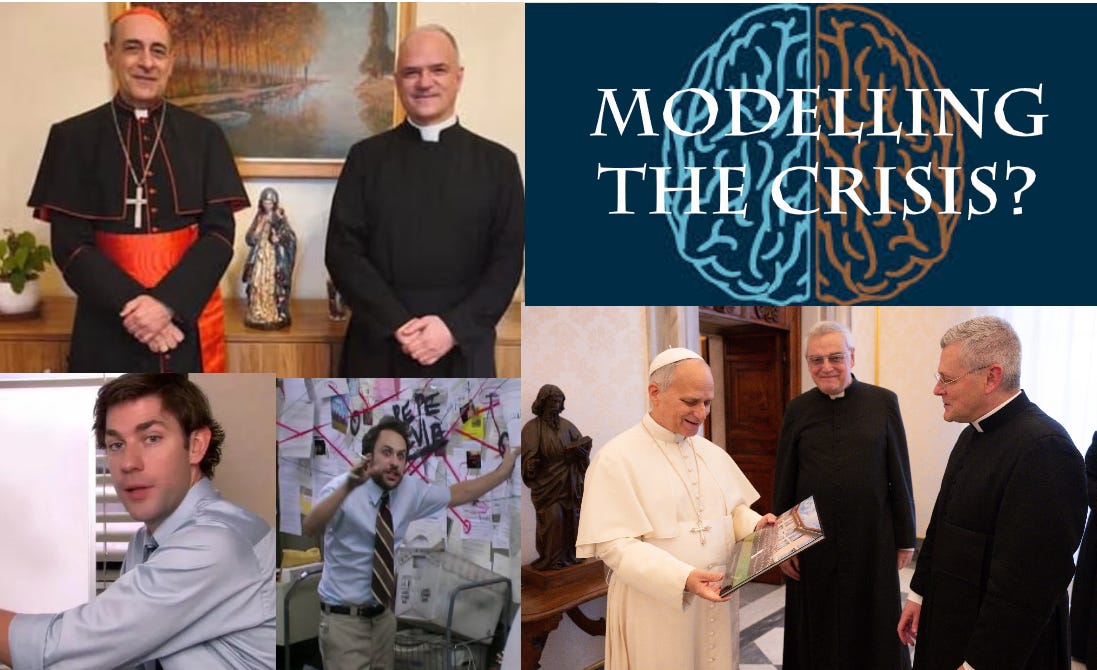
It’s no secret that tensions are rising between different camps or viewpoints within the traditional Catholic world and have been doing so ever since Pope Leo XIV’s election, especially as the approaching SSPX bishop consecrations and the Vatican’s response threaten to cause further division.
But the question little asked, perhaps because we all think it’s too obvious, is why we’re divided.
We already think we know the answer. “The other side’s lying. Their supporters and writers are grifters writing sensational clickbait or tranquilizing sophistries to lull their readers into a false sense of security. They or that group is controlled opposition. They’re overly intellectualizing. They’re catastrophizing! They’re sellouts. They’re schismatics,”
Ok, maybe one sides completely all the way right and we need to follow one particular person’s twenty-step-take-back-the-Church-plan to end the crisis properly with the prudential reasoning that they and they alone managed to get perfectly right. Maybe the SSPX position is perfectly 100% right in every detail, or make that the FSSPs. Or maybe the conservative Catholic fearful of traditionalist scrupulosity and Pharisaicalism is the prudent one in the room we all need to listen to. Maybe one of the endless varieties of Sedevacantist positions is the only one properly addressing the crises of faith in our age.
All have arguments, many of them strong, for why their position is the one everyone needs to listen to and of course everyone claims that the correct position, the correct camp and the correct master plan is the one that they hold.
But unless just about everyone really is a grifter, or lying, or irrational, however, the division between Catholic traditionalists who otherwise have much in common with each other still doesn’t make sense.
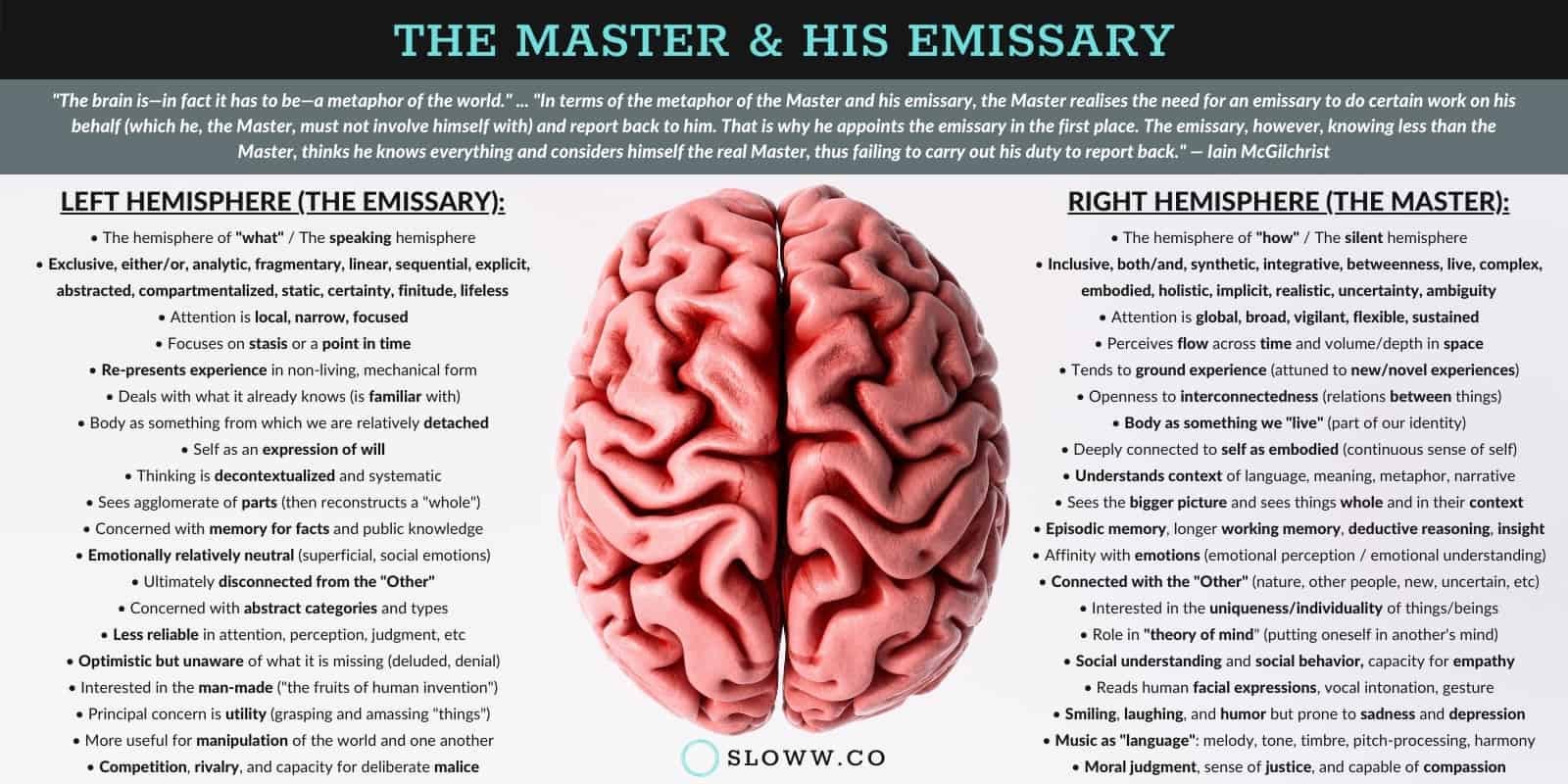
We’re divided by our rationalizations and the models in our heads of our particular moment in history, and not, for most of us, really on any substantial moral issue or question of faith. We’re divided less by the reality outside us or than by our own attempts to model it, which as in the research of Iain McGilchrist in The Master and His Emissary, is the domain of the left hemisphere of the brain, the more cogitating, gnostic and detached from the world part, one that seeks—but can never find—absolute certainty, gets stuck in a feedback loop because it depends on its own models of reality, rather than the encounters with reality itself that are the domain of the right hemisphere, and dislikes, or is perhaps even blind to mysteries and unanswered questions, preferring instead to force everything into simple binaries.

With Hearts Split Apart
We’re all susceptible, in the bureaucratic, impersonal, increasingly schizophrenic age of modernity that technology has enabled, to the same pathologies of left hemisphere overreach that, I argued, were infused in the modern liturgical reform movement and the Novus Ordo. We throw around the term modernist with regard to a certain group of people who, from a pathological disregard of reality, natural and supernatural, have a particular set of heterodoxies. But it’s just as possible for us, living in the same world, to be susceptible to the same pathologies of the left hemisphere, just in a different way.


The issue that more serious minded Catholics face isn’t abandoning the faith, but perhaps over-rationalizing it due to the general overreach of the left hemisphere, leaving out the one sense of faith as fidelity to God, and leaving us, in a search for grounding our certainty, trapped instead in irreconcilable mental loops about our own models of the world/crisis, with the ensuing belief that anyone who disagrees must be foolish or working from ulterior motives. Worse, since we know on some level that we can’t trust our own models, we never actually are certain about our own modelling of the situation.


The end result of such over intellectualization is that our minds and hearts, no matter how certain we may wish to project ourselves to other “camps” about our own “views”, are split apart, uncertain, scrupulous, even paranoid due to the same pathology that’s driving the world anxious and mad, what McGilchrist terms a left hemisphere psychosis or which Dr. John Senior of the Integrated Humanities Program called a disconnection from reality.
Rectifying the Imbalance
The moral crux for us isn’t that there is a problem, but, just as with Vatican II and the Novus Ordo having succumbed to the neuroses of modernity rather than strongly reacting against it, in that rationalizing faith and being paranoid in online internecine warfare with other traditionalists merely reinforces the same neuroses at the root of our division.
Trusting in our own or our favorite commentator’s reason and understanding is only going to further discombobulate us, because, if we’re being honest with ourselves or others, as I certainly admit, we’re not as certain in our models or our own camp as we claim. As one friend (of many I’ve spoken with) put it:
When we try to address the problem of left-brain dominance, we are necessarily tapping into left-brain procedures such as language and argumentation. We risk going the route of denuding abstractions and narrow focus rather than holistic vision and attentiveness to reality in its irreducible complexity. Anger, too, is the one emotion that seems solidly left-brain, and when you think about how consumed with anger and frustration so many Catholics are, you can see that reactionism becomes part of the vicious cycle of self-absorbed rationalism.
We can’t master plan or strategize our way out of traditionalist divisions any more than we can solve the broader crises of our age, but we can, rather than triumphantly claiming we have it all figured out, fight the left hemisphere imbalance within ourselves:
In answer to the left hemisphere’s inwardly directed, closed off to the world pride, rationalism, and gnosticism, Iain McGilchrist argues in The Master and His Emissary that we need to re-habituate ourselves to go out of ourselves, towards the other generally, but in particular towards God, physical reality in all its complexity, and beauty, and by encountering these, not just reasoning about them. And one way this applies to many of us is that we should more honest about our own uncertainties, more focused on our personal doing of the faith than on the ideological purity of those already close to our own side.
The problem of traditionalist division isn’t immediately solved by the obvious shift to prioritizing our own relationship of charity with God and with each other, but at least it becomes a little less acute if we stop pretending to assume that we’re going to be judged for our own private judgement and intellectualizations. It certainly becomes a lot easier to identify with compassion and openness to our fellow Catholics if we realize that they too, most likely, are just trying to do their best in a confusing crisis with limited information. If we’re talking scrupulosity here, or prudence, and there’s sometimes a fine line between the two, the safest choice is not to get involved in the internecine debates, or to overly let them affect our practical decisions.
Against the internecine, trad-against-trad Pharisaicalism about our systems of belief about “the Crisis”, we cannot solve the problems of today through a master plan or one particular system because the problems of our age and in the Church are caused by the inflexible and impersonal world brought out by the left hemisphere and too many systems. Strict legalism has never been a sufficient guide for human affairs in the past, and it is even less so today in the debates between factions in the Church. If practical wisdom were simple, it wouldn’t be called wisdom. The answer isn’t an all-is-permitted-anarchy-without-any-order either, but the answer to the crisis in our age, to our division over it, and to the neuroses and scrupulosity that stem from it is getting out of our heads and doing.
I’m rather “ecumenical” in believing in the goodwill and that there are some good points made when it comes to Catholics of serious devotion but different stripes in the ways that Fr. Nix recently pointed out here. I’m friendly with many who are derided for not being “trad enough” and see the prudence in their focus on the liturgy and personal holiness. I’m friends with many of the so called “neo-trads” or “mad-trads” and see many of their points about certain major issues not being addressed by other commentators. I’m friends (yes) with so-called “anti-trads”, seeing some merit in their critiques, often from personal experience, of the sometimes Pharisaical and overly scrupulous, sketchy attitudes in some traditionalist communities. 1

My point is that even if there are errors that do need to be resolved in each other’s positions, there are good points, and goodwill behind even these differences between Catholics, and we need to be more open to each other lest we destroy each other or our own sanity and faith, in the process.

The Catholic faith is not Russian Roulette. It is not something that should be defended out of fear, pride, anger, or revenge. It is not something so hidden as merely to exist in one “resistance to a resistance to a resistance” group. Yes, it is infiltrated and under attack, but neither is it so hidden or intellectualized as to be something that only experts who have read every single theological treatise can discover or truly be a faithful part of.

Faith is not just holding the right set of intellectual propositions or congratulating ourselves on reciting the right formulas. It is these, but it’s also holding steadfast, not just in our mind, or a single part of our brain, but as a whole person, to the Divine Person, the Word Incarnate. Faith and charity are inseparable, and excessive rationalization of the faith either ruins our charity or splits apart our heart.
Reason, and the left hemisphere mind’s pride in it separates, while love, which the utilitarian pragmatic left hemisphere is blind to, unites, but it can do so, not by master plan or arrangement enforced from above, through passing on the love of God, received and accepted individually as a gift.
To this end myself, having deeply fallen in the shadow of my own critique here on Grain of Wheat with all my focus on and attempts to model the causes and the prognosis of the crisis in the Church, while I’m definitely not closing the door on further writing, I have decided to seriously rebalance and do less here, even as I’m continuing my satire writing (with expanding projects to come) as I’m unsure whether my engagement with thinking about the crisis has helped bring me anything like the peace and charity that a deeper liturgical life, friendships, or encounters with beauty rather than writing endlessly just to say something or prove a point over and above some other side.

My satire writing, at least for now, and if not directed only in one direction, feels mostly positive and cathartic in its impact and import, but I’ve been told by contrast in spiritual direction that writing, at least in its current form, is not likely to be something I should do as much of, for many of the same reasons I’ve outlined here, that it leads, as I’m ironically doing right now, to over-intellectualization of a problem that is itself caused by over-intellectualization.

Ironic, I’d say, but perhaps I’m providing a very good example right here of what not to do in this article, telling you what not to do.
In the end, charity, true charity, the self-sacrificing even unto death charity of the Savior, is the only thing that matters.

I’ve been blocked my Fr. James Martin, so I have no friends in that corner of synodal-happy Catholicism.
As much as I’ve enjoyed your writing on the topic of the crisis in the church, and as excellent as this article is, I’m very glad to hear the conclusion that you’ve come to. I’m sure it’s not easy to rethink and back off from something you’ve been committed to for so long, so I want to commend you for the courage that it takes.
I’ve always gone back and forth between over intellectualizing and living out my faith in the real world, living a liturgical life. Recently I’ve basically committed myself to the latter, and my relationship to God and to the people in my life have been thriving because of it.
One book that reaaaally helped me in this regard-despite some controversy around it-is ‘Mysticism, Magic, and Monasteries’ by Sebastian Morello. As it turns out, our Catholic tradition is much more magical and embodied than trad social media had me believing.
His diagnosis of the crisis mirrors your work, especially your last two articles, albeit using different language and looking at it from a philosophical and metaphysical standpoint. And his antidote is very similar (in my eyes anyway) to the conclusion that you’ve come to, although he’s fleshed it out quite a bit more. If you haven’t read it I think you might get some good out of it!
I look forward to seeing where you go from here!
I've enjoyed your writing even when I've disagreed good luck on future
I have always enjoyed your writing, even while I may disagree, it will be sad to not see a good moderating voice go. That being said I pray for success in future adventures and be sure that IIT beats out the Herod Fable or whatever it's called.
I remain skeptical of applying wholistic psychological models in definitive ways. I don't discount that it can apply in particular and can't say where the line between the two is...
That being said the model reminds me of Thomas Sowells Constrained vs Unconstrained vision political philosophy. Where one vision disregards human considerations as arbitrarily limiting what could be. The other doggedly insists those constraints are real and must be considered and worked within. Generally speaking constrained is conservative and vice versa, although it doesn't map perfectly to a conservative liberal binary.